Showing posts with label Illness. Show all posts

Sunday, 12 July 2020

As Lockdown eases, please remember those of us who continue to live in Lockdown

The last few weeks have seen pretty huge changes in the UK as lockdown measures have started to ease. More children are back at school, more people are going into work, non-essential shops are re-opening, you can enjoy a drink at the pub or go to get your hair cut and people are now allowed to visit zoos, the seaside, their family. You could be forgiven for thinking life is going back to ‘normal’ (although we are far from normal yet with the virus still spreading). But not everyone is escaping the lockdown restrictions. There are a group of people for whom lockdown will continue long after we get on top of this virus – those who live with disabilities and/or chronic illnesses. 


For us, lockdown didn’t start on the 23rd March 2020. Some of us have been living in lockdown for months or even years already. My ‘lockdown’ began at the age of 15, when I became really unwell with what we originally thought was ‘just’ M.E. Over the years though, the M.E. diagnosis has been added to and I now know that I also have a whole collection of chronic illnesses including Ehlers-Danlos Syndrome, Postural Orthostatic Tachycardia Syndrome, Gastroparesis, Bladder Dysfunction, Mast Cell Activation Syndrome and a few more problems thrown in for good measure. I’ve spent much of my life unable to leave the house (and sometimes even unable to leave my bed). I’m ‘lucky’ at the moment – if I need to, I can leave the house for a medical appointment or the odd ‘nice’ thing. But I’ve been through many a period where even getting to an essential medical appointment has been impossible. And I have friends who have spent years trapped in their homes because they’re simply too unwell to even get down the stairs. 


When lockdown was first implemented, there were a lot of conversations on social media about how awful it was going to be to have to stay at home for the majority of the time, or to even have to self-isolate completely for two weeks if there was a possibility of having the virus. People spoke about how upset they were that their plans had been cancelled, they were worried about their jobs, holidays weren’t going to happen and people were concerned that there was no end date in sight. These are all completely valid concerns for anyone to have. But I know to begin with, a lot people in the chronic illness and disability communities (myself included), found these conversations really hard to hear. We have spent large chunks of our lives being hidden away from the world, forgotten because we are behind closed doors. We have had to grieve for the lives we have lost, the careers that have been abruptly ended, the plans that may never be able to happen. This is our reality. So to hear everyone suddenly discussing how awful it was going to be, when we have been dealing with it alone for so many years, was really hard to get your head around. 


But as time went on, things changed a bit. The world started to become a bit more accessible. Working from home and in a flexible way became the norm. People started utilising facilities for virtual meetings. Friends used video calls to keep in touch. Suddenly virtual parties and quizzes became the way people chose to socialise. Attractions quickly started to provide online content so they could still be experienced without having to go there in person. It was soon possible to watch a West End musical or play from the comfort of your own home. Medical appointments were offered via video call, rather than having to travel miles to be seen in person. Communities came together to ensure those who couldn’t leave the house were given food deliveries, medication and phone calls to check they were OK. Articles were written and videos were made about how to support each other while we had to stay at home. 


The world actually started to care about people who couldn’t leave the house because it was something that was affecting healthy, non-disabled people. Accessibility options and adaptations that the disabled and chronic illness communities have been fighting for for years were brought in overnight. After spending years being told we couldn’t work from home or that we would have to miss out if we couldn’t get somewhere in person, these things quickly became possible when the rest of the world realised they didn’t want to lose out. And to be totally honest, it really hurt to see how easily these measures could be put in place if people just tried. 


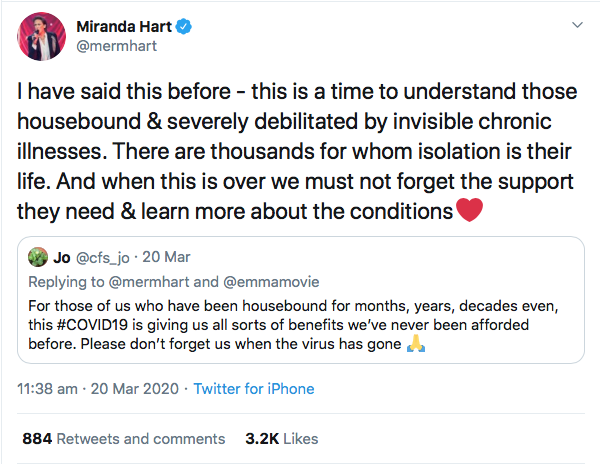
It’s hard to talk about positives related to the Coronavirus, because so much pain and suffering has come from it. But one positive thing the virus and the resulting lockdown have brought is that they have opened peoples’ eyes to the lives of those with disabilities and chronic illnesses. It’s something that Miranda Hart has spoken so eloquently about recently, both on Twitter and on Instagram. The last few months have given non-disabled people a rare insight into what it’s like to have a disability or chronic illness. Of course, it’s not the same. Although there’s uncertainty, there is the prospect of an end date one day with lockdown/the virus, which those with chronic illnesses and disabilities don’t have. But non-disabled people have, often for the first time, experienced how an illness can bring your whole world crashing down around you. They’ve experienced the grief of looked-forward-to plans being cancelled. The fear of seeing an illness, which is out of your control, impact on your ability to earn money and have a career. They’ve seen how hard it is to have to stay at home for most of the time, not able to go to work, to the shops, to socialise with friends or to even get medical care.


Of course, I wouldn’t wish these things on anyone and I certainly wouldn’t have wished for a global pandemic to make these things a reality for everyone. But that’s what’s happened, and I think it’s important that we as a society learn things from our experiences so we can make the world a better place for everyone. Over the course of lockdown, I’ve had people tell me that they had no idea being housebound was so hard. People have said that they didn’t realise until recently the grief that comes when an illness destroys every single part of your life. There have been conversations on social media about what it must be like to be housebound all the time. People have expressed how great all these new accessible measures are. But those conversations are already dwindling. 


Life is getting back to some sort of normality and people are already forgetting their experiences of being housebound. Working from home is becoming less straightforward and the expectation to be back there in person has returned. People aren’t so interested in video calls and virtual groups because they can meet people in person again. Attractions have stopped making virtual content accessible. Those who can’t leave the house are now expected to try and fight for online food deliveries and the phone has stopped ringing with people checking you’re coping OK at home. Most people are getting back to ‘normal’ and are leaving those with disabilities and chronic illnesses behind again. Now that the problem of being housebound isn’t affecting the majority, the drive for non-disabled people to fight for accessibility just isn’t there any more. And we desperately need healthy, non-disabled people to be fighting our corner and being an ally too. 


There is so much that the world could learn from the last few months that would really help those with disabilities and chronic illnesses. So if you’re reading this and wondering what you can do to help us and make the world more accessible, I thought I would list just a few things that you can do to become an ally to disabled and chronically ill people:


·      If you own a company or work in any kind of management role, look into ways that you can help to make working flexible. Obviously some roles don’t lend themselves to working from home, but you could also look at flexible hours or the option to work part-time. And there are many jobs that can be done from home, as the lockdown has shown us. Don’t automatically dismiss job candidates with disabilities or those who ask about adaptations. Talk to them and find out what would make it easier for them to work with you. We are disabled/chronically ill, but we also have so much to give if we are just given the right adaptations for our needs


·       If you have a friend or family member with a disability or chronic illness, please just remember them. I’ve lost count of the number of times someone has said to me, “Oh I didn’t invite you because I didn’t think you’d be able to come.” Please don’t make decisions for us. Invite us to social events and let us decide if we are well enough or if adaptations need to be made


·      If someone with a disability or chronic illness isn’t able to come out in person, look at ways you can adapt to still include them. Ask them if they’d like to chat on the phone or by video call. Is there a way they could get involved with something virtually? Could you perhaps organise some events, such as virtual quizzes or group video chats, that are accessible to them from the beginning? I think the biggest thing is just not to forget them just because they’re not there in person


·      If you work for an attraction (whether that’s a theme park, museum, zoo, gardens or anything else), try to continue with virtual content. Virtual tours or videos have allowed some disabled people to experience ‘going out’ for the first time, when ordinarily they would have no hope of being able to enjoy that attraction


·      Also look at ways the attraction can be made more accessible to those with disabilities/chronic illnesses that might be able to visit in person. Are there enough accessible toilets? Is information in an accessible format? Please actually speak to disabled people and get our views on accessibility measures, as we know what adaptations we need


·      If you work in the live entertainment industry (i.e. putting on musicals, plays, concerts and other live events) consider whether you can continue to provide video content that people can watch from home. During lockdown, some disabled people have been able to watch a West End Musical or enjoy a concert by their favourite musician/singer for the first time, and it’s been great! Accessibility can be a huge problem when it comes to live events and entertainment, so having the option to watch something from home, at a time that suits the individual, is invaluable. There’s no reason you can’t charge for this service either – I don’t think disabled people would expect to get this sort of content for free. So it’s another possible avenue for much-needed revenue, especially at the moment when entertainment venues are struggling so much, and makes live events inclusive for all


·      Although some disabled people may not be able to visit places like theatres or arenas, there are also a lot who can as long as the correct adaptations are in place. So please help disabled people to feel welcome by ensuring access is suitable for a whole range of needs (and again, please talk to us to find out what we actually need). For example, make sure the booking process is accessible, that there is enough accessible seating (both for those in wheelchairs and those who may not be able to walk far/climb stairs), that there are accessible toilets and that programmes are available in different formats


·      It would help a lot of people with disabilities and chronic illnesses if the NHS could continue to make greater use of virtual medical appointments. Obviously these aren’t suitable for all appointments – we will still need to visit hospitals for tests, treatments and appointments that require us to be examined or seen in person. And sometimes I quite appreciate being able to see a Doctor in person. But for a lot of appointments, talking on the phone or by video call would be absolutely fine. Virtual appointments would save us having to use limited energy to travel long distances, would mean we could save money on travel costs and parking and would also mean that those who are too unwell to leave the house can still access the medical care they so desperately need


·      I think it would be great if we continued to be more aware of those in our local community who might be housebound or who find it difficult to leave the house. In our community a series of Facebook groups have been set up so that those shielding could ask for help if they needed it. I would love to see these groups continue to be used once lockdown has eased, to try and continue to help those who might need it. But more than that, we need to be checking on our neighbours because not everyone will have social media. If everyone checked on the neighbours around them, then no one would have to face the world alone. So why not drop a note through your neighbours’ doors to let them know your details if they need anything. Get to know the people who live around you – sometimes disabled and chronically ill people may not need any practical help, but would just love some social contact


·      And in the wider society, it would be great to see a bit more focus on those with disabilities and chronic illnesses. I’ve seen a lot more articles written by disabled and chronically ill people during the pandemic because the media realised we have something to contribute on this particular issue. But this inclusion needs to continue – our experiences matter. And we don’t just have to contribute to disability and health related topics – we have other talents and views on a whole range of other things too!


I think the biggest thing society can do to be an ally to people with disabilities and chronic illnesses though, is to listen to us, include us and remember we exist. Please, if you take one thing away from lockdown, let it be an increased awareness of what it is like to live with a disability or chronic illness. This period of time has given everyone a unique insight, albeit only a brief glimpse, of what it is like to have restrictions placed on your life by uncontrollable health circumstances. You have experienced the fear and anxiety that comes from a medical condition, the grief that comes from having your plans cancelled and having no control over when you might be able to do things again and the overwhelming loneliness and isolation that comes from staying in your home for months on end.


So please, don’t forget how these experiences made you feel because that is just a tiny taster of what it can be like living with a disability or chronic illness. Use your increased knowledge to reach out to family and friends with disabilities and chronic illnesses. Find ways to do what you can to make the world more inclusive and accessible. Join disabled people in fighting for equality and respect. And above all, please, just don’t forget that there will still be many people living in lockdown when you go back to your normal life. 


Has lockdown helped you to understand a bit more of what it can be like living with a disability or chronic illness? Or as a disabled/chronically ill person, have you noticed any positive or negative changes as lockdown restrictions are being eased?


Wednesday, 26 June 2019

Our Experience of Dementia

If you follow my YouTube channel then you might have seen I recently made a video about our experience of Dementia. I thought I would also write a corresponding blog post about the topic, as I know different people prefer to consume different types of media, and I think it’s an important subject to talk about with as many people as possible. 

One of the reasons I decided to talk about our story is because, on the 13th June, the Alzheimer’s Society organised a national Cupcake Day in order to raise awareness of dementia and to raise money in the fight against it. Their reason for using cupcakes was:

“In the average time it takes to bake a batch of cakes, six people in the UK will develop dementia. It is now the leading cause of death in England and Wales, overtaking both cancer and heart disease.”

With the number of people who develop Dementia, I would be surprised if you didn’t know someone that had/has the disease. Unfortunately, it’s something that has touched my family’s lives and mine deeply, and so today, I would like to tell you all about my Gran. Rather than launching straight into all the awful things dementia brings, I want to start by telling you who my Gran was and what she was like before the dementia hit.


My Gran was called Patricia – some people called her Pat, some called her Trish – but I just called her Gran or Granny. She was born on the 5th December 1923, at home in Wembley, London. A few years later, her younger brother, Robert, came along too. I don’t know a huge amount about her early childhood – we’ve looked through some of her things, mainly from her adult life, but there are still photo albums and papers that we need to go through at some point.


I started to find out a bit more about her when she became a bit older and joined the W.R.N.S (Wrens), which is otherwise known as the Women’s Royal Naval Service, during the Second World War. She was one of the first female commissioned officers to be in the Wrens, which is a pretty monumental thing for any woman to do! When she joined, like all the other recruits, she had to take a compulsory sight test. Unfortunately, she was blind in one eye and had been for as long as she could remember. But this wasn’t going to stop her from helping her country. Instead of giving up, she memorised the whole sight test – where every letter on the chart was – so that when she went to be tested and her good eye was covered, she could give the illusion that she was able to read the chart. Although perhaps not the best thing to do, it just shows what kind of person she was. She wanted to pitch in with everyone else and do her bit for her country. 


In the Wrens, she worked as a secretary and was in charge of a team who typed up the orders for the D-Day Landings. They were all hidden away in a secret building, which was obviously closely guarded to stop any enemy infiltration. She always used to tell us how, if they wanted to go to the loo, someone would have to escort them there, wait for them to go and then bring them back to the room again in order to maintain the highest level of security. I can’t imagine what it must have been like to be typing up something like that, although I guess at the time, they probably didn’t even realise what an important part of our history it would become. But knowing she played her part in getting us our freedom makes me very proud.


After the war, my Gran continued to work as a secretary and married Alan, my Grandad, in 1952. A few years later, in February 1957, my Mum came along. As my Mum grew up, the family moved around a bit, starting with moving to Harpenden and then on to Felixstowe. That’s the first place I remember them being, as I lived in Felixstowe for the first couple of years of my life and when we moved to where we live now, we would often go back to visit my Gran and Grandad there. 


I have very fond memories of my Gran and my Grandad growing up. We were very close to them and they really doted on my siblings and I. In the summer holidays, I would go and stay with them for a week, and used to love having my own little holiday there with them. They would take us to the beach, we’d go to the pitch and put, go out shopping with them and my Gran would always bake cupcakes with us. I loved them both, but my Gran was always on the ball and so incredibly caring. I remember her hugs being the absolute best! If I could go back in time to those happy days with them, I would go in a heartbeat. 


As her and my Grandad got older, they decided that they wanted to move to be closer to us. Felixstowe was a fairly long drive away, and if anything happened they wanted to be close by to family. They moved to somewhere called Fleet, which is about a fifteen minute drive from where we live, and lived in a flat with a warden who was there to look out for all the older residents. Their time in Fleet to begin with was very happy. It was lovely having them closer to us, as it meant we could see them more, and they seemed to settle in well to their new community.


But in 2007 everything changed in a matter of minutes. My Grandad had a massive stroke at home, and when he reached the hospital we were told to prepare for the worst. They didn’t think he would make it through the night. But I guess they didn’t know how determined my Grandad was, because he proved everybody wrong! He recovered enough to not be deemed in a critical condition any more, but unfortunately the stroke had still had catastrophic consequences. He was no longer able to speak, eat or walk and had become incontinent. After being moved around various hospitals for rehabilitation, he was eventually moved to a local nursing home. The most painful part though, was that his mental ability hadn’t changed. It was obvious he still knew exactly what we were all saying and understood everything that was going on – he was just trapped inside his body. I can’t imagine how difficult that must have been for him.


Looking back, I think this was a huge trigger for my Gran’s dementia. I can’t say that it caused it completely, because dementia is a complicated thing, but certainly the stress and grief that came with my Grandad’s change in health seemed to set off a spiral in my Gran’s wellbeing. She was now living alone in their flat and found it incredibly hard accepting the situation my Grandad was now in. It was like grieving for the person she loved, yet he was still alive. 

It was around this time that we started to notice that things weren’t quite right. She would sometimes stumble over her words or struggle to find the words she wanted to say. This brought with it huge amounts of frustration and we noticed her also becoming more anxious, but it wasn’t really enough for us to be able to put our finger on anything or bring in the doctor. We thought it might just be the stress of my Grandad’s illness, having to live alone for the first time in years or just signs of getting older. How wrong could we be?

My Grandad defied all the odds and continued to live in the nursing home until he died, three years later, in 2010. Over those three years, we had continued to notice a decline in my Gran, although she was still living fairly independently, with the help of regular carers. It’s so difficult in the early stages to judge whether it is just normal aging and a slight forgetfulness, or if something more is going on. If we went through it again now, then perhaps we would notice sooner, but at the time we just didn’t know that much about dementia. 


After my Grandad died, we began to notice a much bigger decline in my Gran’s functioning. We would get phone calls from the carers saying that they had left her with her evening meal the day before, and the next morning it would still be sitting on the table untouched. She was also becoming a lot more agitated and upset, mainly due to her memory loss and the frustration she felt at not being able to remember things. We were also getting a lot more phone calls from both the warden and the staff on her helpline button saying she had fallen or that she was very agitated/upset about something, so my Mum especially was driving back and forth between our house and her flat constantly. 

One particular phone call that I will always remember came quite late one night. It was from the warden, who told us that she had found my Gran walking around the car park in her nightclothes in a very distressed state. It turned out my Gran had thought that we were going to pick her up, so she had gone outside, without her key, and then couldn’t get back into the flats and so had got really scared and upset. This is when we realised that this wasn’t just ‘normal’ aging and that something more serious was going on. The current situation wasn’t working for anyone – my Gran was starting to put herself in danger because of her confusion and my parents were exhausted from driving back and forth between our house and her flat so often. Something needed to change.

So we spent a lot of time considering what the best next move should be. We considered a nursing home, but were really concerned that my Gran wouldn’t settle in one because of her confusion. In the end, we decided to move her in with us, so we turned our downstairs study into her new bedroom and she came to live with us permanently in 2011. 


Over the next four years of her living with us, things just got progressively worse. She eventually got to a point where we started getting doctors involved and she was then officially diagnosed with dementia, although we had already suspected that would be the diagnosis. Unfortunately, although the diagnosis gave us a name for what was going on, it didn’t bring with it any real treatment or hope. She tried a few different medications that can help with some of the symptoms, but in her case they either made her symptoms worse or turned her into a complete zombie, which we didn’t want. In the end, we were discharged from the psychiatrist and were left to cope with how things were going and find our own ways to try and manage.

Her dementia definitely went through quite defined stages. To begin with, there would be times when she was really confused, but then other times where she was quite lucid and, to the outside world, probably looked like any other person. I think for her though, this was one of the most difficult phases, because she still had that awareness and knew that she was getting confused, which led to a lot of frustration and anxiety. 

She would tell all sorts of stories – for example, she was convinced that they were building underwater bungalows at the bottom of our road. She told everyone about them and asked how they were getting on all the time. In the end, we had to take her out in her wheelchair to show her they didn’t exist. Another time, she told her carers that we had been burgled in the night and that she had hit the intruder with a frying pan to get him out of the house, and then had gone to the locksmith to get all the locks changed. At first, the carers believed her because she sounded so convincing and she truly believed these things were happening. 

Looking back, it sounds quite funny now, but at the time it was heart breaking. We learnt not to challenge her or argue with her when she came up with these stories because it only made her more upset. The only times we had to correct her were if it would put her in danger or if it was something she genuinely needed to know. She would often forget that my Grandad had died, so time after time we would have to break the news to her and she would react as if it were the first time she had heard about it. It was a horrible situation. 


During this phase, her eating also changed. Years before, she had been diagnosed with Type 2 Diabetes and since then had always been very careful about what she ate. But now, she would just eat and eat and eat. It was like there was no regulation from her brain on when she felt full and she honestly couldn’t remember that she had just eaten. She would finish a meal and we would sit her back in the lounge, and then she would ask us when it was time for her breakfast/lunch/dinner. Because she couldn’t remember having eaten anything, she would get quite cross with us because she thought we were lying to her and not letting her eat, which was particularly difficult. 


Then things changed again, and the next phase of her dementia seemed to kick in. She became incredibly emotional, tearful and anxious all the time. She wanted someone to hold her hand all the time and was absolutely terrified of falling. It was very difficult to comfort her because a lot of the time, she didn’t understand what she felt so upset about, and if we did calm her down, she would soon forget and the process would start again. 

In this time, her eating was flipped on its head. She went from eating loads, to not eating very well at all. It sounds awful, but it was almost like she had regressed back to being a child. She would refuse to eat her vegetables or anything healthy, and all she wanted were cakes, puddings and anything sweet. But unlike a child, you couldn’t reason or explain things to her because she simply didn’t understand. And in the end, after speaking to our doctor, we just had to give her whatever she would eat because it was either that or nothing. 

And more and more of the time it became nothing. She would often just sit and look at the food in front of her, but wouldn’t eat it. Even when we asked her if she was going to eat it, she would say yes but then not do anything. It was as if her brain just didn’t make the connection between the food in front of her and needing to eat. She didn’t know how to pick up her cutlery or how to feed herself, and I don’t think she actually felt, or understood that she felt, hungry anymore. At this point we resorted to having to feed her to get some kind of nourishment in her.


This phase just seemed to get worse and worse as time went on. As well as being very emotional and agitated, she also started to become aggressive. It was horrible to see because she had always been such a kind hearted, gentle person – it just wasn’t her any more. She would hit and bite her carers, often through fear because she didn’t understand they were trying to help her, but her aggression would also come out with us as well at times, although with us (and my Mum especially) it was more verbal than physical. I know my Mum really struggled with the person my Gran was becoming because she was so far removed from the Mum she used to know. 

It was getting to the point where she didn’t really know who we all were any more. She would often refer to my Mum as a member of staff – I’m not sure if she thought she was in a care home or something – but she would regularly tell my Mum that her daughter never comes to visit her. And even when my Mum explained that she was her daughter, my Gran just couldn’t see that. But she still desperately wanted someone with her all the time because she was becoming more and more fearful and upset about things. It became incredibly difficult, especially at nighttime when she would constantly call out for help and want someone to be with her. She couldn’t be left alone in the house, which obviously had a big impact on our lives as well, and although we had managed to get a couple of hours of respite care, the majority of the caring came down to us as a family, and my Mum especially. She couldn’t walk, so had to be hoisted, she was incontinent, she needed help with eating and drinking and just generally needed a lot of emotional support.

By this point she was barely eating anything at all – she just didn’t seem to know what to do with food, even when we tried to feed her. Because of this, she was losing a lot of weight and became incredibly thin. It was a stark contrast to how she was when she was well because, although she hadn’t been fat, she had always really enjoyed her food. It was also impossible to give her any medication because she simply wouldn’t take it.


Getting medical care for her was also incredibly difficult because she could no longer leave the house. Thankfully we had a brilliant GP who would come to visit her, but apart from those visits we were pretty much on our own. We did manage to get a couple of hours respite care a week from The Princess Royal Trust for Carers and it was honestly a lifesaver. It gave my Mum a bit of time to herself and meant she could actually leave the house without worrying that my Gran wasn’t getting the care she needed.

I feel awful saying it, but some days we would just wonder when it would all end. We loved my Gran so very much, but this wasn’t really my Gran any more and it was incredibly hard some days to find that love we had for her and keep caring for her. I hate saying that because it makes it sound like we didn’t love her or that we resented her, and of course that isn’t the case. It is just incredibly hard seeing someone you love change beyond all recognition and fade away before your eyes. We had no idea that dementia could be this devastating and had no idea just how much of a person it could take away. 


In the November of 2015, my Mum had gone out early to take my sister to the hospital to sort out a broken arm, so it was left to my Dad and I to wake my Gran up in time for her carers to arrive. On any other day, I would have gone and opened my Gran’s bedroom door to wake her up myself, but for some reason on the 18th November 2015, I decided to wait so my Dad and I could do it together. We opened the door and said our usual “Good Morning” but it quickly became obvious that something wasn’t right. My Gran had, sadly, died in the night. 

The whole situation affected me a lot, and I ended up having to have bereavement counselling afterwards. I had never seen anyone dead before and without going into too much detail; it didn’t look as peaceful as you’re often led to believe in TV and films. My Dad phoned my brother straight away – he’s a paramedic and was at home, so he said he would come straight round to do some checks on her. I also rang our Doctors Surgery and asked if I could speak to a doctor. I was told I could have an appointment for two weeks time, and at that point I think I just burst into tears and told the receptionist that my Gran had died in the night and I didn’t know what to do. She was absolutely lovely, reassured me (she knew who I was, and knew that my Gran had a Do Not Resuscitate order) and organised for a Doctor to come to the house to certify the death.

Waiting for the doctor to come was the strangest wait I think I’ve ever had. I knew my Gran was lying in her room not alive any more, so I couldn’t just go and get on with the rest of my day as if nothing had happened. We ended up all just sitting around talking about nothing in particular until the Doctor arrived. He organised for a private ambulance to come and collect my Gran to take her to the funeral directors. But my Mum still wasn’t back, and therefore still didn’t know what had happened. We were terrified that she would get back to see a private ambulance on the driveway, or, even worse, that they would want to take my Gran away before my Mum got home. Thankfully, my Mum arrived home before the ambulance got here. We had to break the news to her and then she wanted to go and say goodbye to my Gran.


Seeing my Gran being taken out of the house in a body bag was the moment that really set off my tears – I think it made the whole thing seem very real. After she had gone, the house felt really empty. Despite my Gran fading away both physically and mentally, she had taken up a huge space in our lives, so for that to suddenly be gone was incredibly strange. All of a sudden, we didn’t have her carers coming in four times a day. My Mum didn’t have to care for her 24/7 – she didn’t need to prepare her meals, to do all of the extra washing, to sit with her in the middle of the night. All of a sudden, there was just nothing. 

Saying goodbye to my Gran, both at the funeral directors (I decided to go and view her body) and at her funeral, was a surreal experience. In many ways, I had already said goodbye and grieved for the Granny I knew and loved for so many years. But despite my Gran not being 'her' for the last four years, there was still so much to say goodbye to and so much to grieve for.


Before my Gran became ill, none of us had any idea what dementia really was. We learnt very quickly that it isn’t just being a bit forgetful or confused – there is so much more. It’s forgetting who those around you are, it’s forgetting who you are. It’s forgetting how to eat, how to walk, how to use the toilet and how to communicate. It’s losing your whole self, bit by bit, and not being able to do a single thing to stop it. It’s devastating.

And that’s why I wanted to share my family’s story. To help people understand just how devastating a dementia diagnosis can be. So that people can know the signs to look out for, and so that we can all be a bit more understanding if we meet someone who might not be acting like everyone else. As I said at the beginning of this post – more and more of us are living longer and more and more of us are developing dementia. We need to support charities like the Alzheimer’s Society who are doing research so that, one day, we won’t have to suffer in the way we have seen our loved ones suffer. 


I’d be really interested to hear your thoughts on dementia – have you known someone with the disease, or have you learnt something from hearing our story? It’s also never too late to fundraise for the Alzheimer’s Society, so please do consider them when you plan your next fundraising challenge

Tuesday, 12 March 2019

My experience of swallowing problems and EDS - Having an Oesophageal Manometry

Since the beginning of the year, you may (or may not!) have noticed that I’m trying to find my feet with blogging again. I went a long time with doing the same old posts and although I was enjoying it, it had become a bit repetitive and so I was starting to lose enthusiasm. So my posts began to dwindle and I put more energy into my YouTube channel (which I also love). But after setting a goal at the beginning of the year to get back to being more organised with blogging and YouTube, I’ve been trying to work out what I actually want from my blog. I’m not sure that I particularly fit into a certain niche – the only one I can really identify with is ‘lifestyle’ because it allows me scope to pretty much post about whatever I want! 

So as well as enjoying posting about beauty, fashion, afternoon teas, books, stationery and all that jazz, I also want to start posting more about health, disability, accessibility and chronic illness. It’s a big part of my life, and I know I will often look to bloggers for advice or reassurance on medical procedures, equipment and just managing life with a health condition, so over time, I would like to be able to offer the same to others. I’ve been through so many different types of appointments, tests, admissions, pieces of equipment and experience, so I feel I have a lot of insight to share. Whether that’s things I’ve been through in the past, or things that have happened more recently. But I thought I would start by talking about my experiences of having an Oesophageal Manometry test. 

I can’t remember if I’ve actually mentioned this on my blog before, but since around this time last year, I have been having problems with my swallowing. It started with a feeling of having something stuck in my throat, which has continued ever since. But now I’m also finding it difficult to swallow solids and liquids – it’s almost like they get stuck with my first swallow, so I need to either keep swallowing or cough to try and clear them from my throat. I get a lot of other digestive symptoms as well (burping a lot, nausea, really painful hiccups, pain, weight loss and reflux) although these could be related to my already diagnosed Gastroparesis and Intestinal Dysmotility. It makes meal times even more difficult than they already were and if we ever have to eat out, I can feel quite self-conscious because I’m aware I’m coughing/choking a lot. My family are used to it by now so it doesn’t faze them, but obviously in a public place it can draw attention. Plus the fact that eating is now an even more uncomfortable experience, which, as someone in recovery from an eating disorder, can be a difficult battle to fight.

Anyway, when these symptoms first came about, I went to see my GP. It just so happened that I had an upcoming appointment with my local Gastroenterologist, so my GP advised me to discuss it with her and see what she suggested. Unfortunately, that initial appointment didn’t go as I’d hoped it would. I explained the swallowing problems, the fact I had started losing weight and how much it was impacting on my life, only to be told it was ‘probably just my Gastroparesis’ and to just get on with it. She also said that I was still a healthy weight, so the weight loss didn’t matter. I remember coming out of that consulting room in tears and sitting in the car with my Dad as he tried to comfort me as best he could. It might sound extreme, but I was devastated. For the next few months, I was back and forward to my GP as she tried to contact my Gastroenterologist and get some proper help, but we were just getting nowhere. Eventually, we were able to get her to admit that this wasn’t her area of expertise and that I should go back to see my Professor up in London. To say a weight had been lifted off my shoulders is an understatement! I have always said that I do not expect doctors to know how to deal with everything, especially when it’s someone like me with very complex and often rare conditions. All I ask is that they can admit this, and pass me on to someone who can deal with it.

My referral back to the Professor came through quite quickly, which was a huge relief. I already had quite a lot of history with him – he had made my initial diagnosis of Ehlers-Danlos Syndrome, as well as doing tests to confirm my Gastroparesis and Intestinal Dysmotility, after years of being told I ‘just’ had IBS. So I have a lot of respect for the way he works and the fact he always seems to listen to his patients. When I went up for my appointment at the end of 2018, I felt nervous, as I do about any medical appointment. I was seen by a member of his team – a lovely lady who made me feel completely at ease. I went through my symptoms and the history of them, and she asked various questions to make sure she had a full picture of what was going on. We also talked about what my local Gastroenterologist had done for me so far, and she seemed genuinely shocked when I told her. It was nice to feel like I hadn’t overreacted about the situation to be honest! Once we’d been through everything, she reassured me that she wanted to get to the bottom of this, and even if it was ‘just’ my Gastroparesis, there were still things we could try to help.

The first thing she wanted me to have done was an Oesophageal Manometry test. I had already had one of these quite a few years ago, during a period of being extremely sick, so she said we could compare the results and see if there had been any changes. If this didn’t give us any answers, she would organise for me to have some further tests to look at other parts of the oesophagus. I came out of that appointment in tears again, but this time they were tears of relief that someone had taken me seriously. 


After a few false starts with my appointment day being changed and then me having to change it because the new date wasn’t suitable, last Friday my Dad and I caught the train up to London. Public transport with a disability is always a story in itself, so maybe I’ll touch on my wider experiences more in a different blog post! But as my appointment was at 10.15am, we needed to make an early start, which meant having to get a commuter train. To be honest, getting the train up to London was a dream this time! I had booked assistance online and although I have no idea whether the message actually got through (a rant for another day!) the guard was very helpful with getting the ramp out and getting me on the train. I read my book for a bit and then nodded off until we arrived in Waterloo. This was where the ‘fun’ began. Because the nearest tube station to The Royal London Hospital (Whitechapel) doesn’t have any disabled access, we have to go by bus instead. In general, I don’t mind travelling by bus – it’s nice to be able to see the streets of London and I don’t get as anxious as I do going underground. But it’s a lot slower than a tube! 

Our first bus wasn’t too much of a problem – I got on without any issues and although the bus took nearly twice as long as it was meant to, we got to our stop without too many issues. We then waited for our second bus and again, got on without any problems. We must have then moved no more than a few metres when the bus just stopped. For a while, I thought it was because the traffic was just being slow, but when I realised we hadn’t moved at all for well over 15 minutes, I asked my Dad if he could ask the bus driver what the problem was, as time was ticking and my appointment time was getting ever closer. It turned out that two buses in front of us had broken down in the middle of a crossroads, blocking traffic from all four exits. Passengers from our bus began to get off, as there was no way we would be going anywhere for a while. Obviously though, to get me off, we would need to put the ramp down, and where we were currently parked, the ramp would have gone straight into a wall. I was desperate to get off, as I was starting to get panicky about missing my appointment, so my Dad asked the driver if he would mind moving forward a tiny bit just so we could put the ramp out. He really wasn’t happy about doing it, and spent ages saying that he wouldn’t. I totally understand that his first priority was our safety, but it’s a horrible feeling to know you are literally held hostage somewhere just because there isn’t an accessible way out.

Eventually, thankfully, he could obviously see how upset I was getting, and he said as long as my Dad stood by the ramp to stop cyclists/motorbikes running into it, he would put the ramp down. I have never been so happy to get off a bus! We went up the road until we could find a dropped kerb and then managed to find a lovely taxi driver to take us the rest of the way. Taxis are probably the easiest method of transport for me in London, but they’re also the most expensive, and I just can’t afford to always travel by taxi just because I’m in a wheelchair. But this was a needs must situation! Somehow, we managed to get to the hospital five minutes before my appointment time, and were told they were running late anyway, so it gave my Dad time to grab some breakfast (I wasn’t allowed to eat) and for us to just de-stress a bit!

Before long, a male consultant was calling my name to come through for the test. By this point I was feeling quite anxious – I remembered having the test before and knew it wasn’t the most pleasant of things to have done. I have also had a feeding tube before, which was a pretty traumatic experience, so whenever I’ve needed a tube since, it has caused a lot of anxiety. Thankfully the consultant was incredibly calming – very softly spoken and went through the whole test with me, allowing me to ask any questions. He also offered me the option of having a numbing spray at the back of my throat – initially I wanted to go for it, but I asked what he would recommend and he said it was worth trying without to begin with so I trusted him on that.


He told me that they would pass a tube into my nose and then down my oesophagus into the top of my stomach. The tube has little sensors on it, which can record the movement of the oesophagus as you swallow food or drink. He said that we would start with me drinking little sips of water. After this, we might progress onto drinking a cup of water very quickly, and if they still needed more results he would ask me to eat some plain-microwaved rice (this actually sounded kind of appealing – I was starving!) 

There was a bed set up next to a monitor, and the consultant asked me whether I was able to transfer to the bed or whether I needed to stay in my wheelchair. I said I was happy to transfer to the bed, so the nurse helped me get into position. She covered me with a huge absorbent sheet (which made me feel a bit like I was at the dentist and was slightly concerned about what they were expecting to happen!) and gave me a sick bowl and some tissues. Then it was time to insert the tube – they could obviously tell I was anxious because the nurse sat next to me, held my hand and told me to take some deep breaths and try and relax (easier said than done!) They gave me a cup of water with a straw and told me to keep taking little sips as the tube went down. This is actually a tip I was given before I had my feeding tube put in but the staff doing that had never heard of it, so it’s good to see that these staff knew how much it could help. I would recommend it to anybody trying to have a tube put in.  

Unfortunately, after putting the tube in my right nostril, the consultant decided it wasn’t in the correct position, so they had to take it out and try again on the other side. Thankfully it went in fairly easily and strangely I didn’t gag at all. It’s an odd feeling having a tube going down your throat and I was very aware of it being there once it was in position. I remember that feeling so well from having my feeding tube (although as my body got used to it I would forget it was there). 

Once things had settled down a bit, the consultant began to squirt a small amount of water into my mouth. I would have to hold it in my mouth until he told me to swallow, then swallow once and stop swallowing until he said otherwise. This was by far the most difficult thing! It’s a natural reflex when you feel something in your throat that you swallow to get rid of it, so I was having a really hard time not swallowing. I think we had to do the test a lot more times than they actually needed because I just couldn’t stop swallowing after taking each mouthful of water. Eventually they suggested that, once I’d swallowed, I opened my mouth slightly and breathed through there – that definitely helped. I think I also began to calm down a bit, so with a mixture of breathing through my mouth and also closing my eyes and doing a bit of mindfulness, we managed to get through that part of the test.

The next part of the test was for me to drink a whole cup of water, as quickly as I could, and then stop swallowing when I had finished. Again, this was easier said than done. I can’t drink very quickly anyway because that feeling of liquid getting stuck starts to build up, so I begin to regurgitate the water and am either sick, start burping or having to swallow until that mouthful has gone down. So I think it took me longer than they were hoping for me to get through the whole cup of water. Again, once I’d finished, I tried to open my mouth, close my eyes and just take some deep breaths to keep myself calm and not swallow.

I was then expecting them to ask me to eat some rice, but the consultant told me they had everything they needed and they could take the tube out. I was a bit confused, and to be honest I wish I’d asked if the test had shown anything (although I’m not sure they would have been able to tell me). But I wasn’t sure why we were stopping and couldn’t work out if it was a positive thing (i.e. they’d been able to work out the problem) or a negative thing (i.e. they couldn’t see anything wrong so had given up). 


To take the tube out, the nurse gave me some tissue and a bowl and asked me to open my mouth a bit and hold the tissue over my mouth. I was fully expecting taking the tube out to be fairly easy, as I remembered it not being a huge deal when my feeding tube was taken out. But this was by far the worst bit for me. My eyes started watering (more so than they did when it was put in) and I started gagging and retching – hence the bowl I guess! It was also quite painful coming out, and left my throat and nose feeling quite sore afterwards. But it was over fairly quickly and I could clean myself up afterwards. Overall, the whole test probably only lasted about 20 minutes – much shorter than I’d expected, although obviously it would have been longer with the food part. 

The consultant explained that he would compare their findings to my last Oesophageal Manometry and send the report to my Professor to discuss with me. I don’t have an appointment date for seeing him at the moment, so I’ll give it a few weeks and if I still haven’t heard anything I’ll have to give his secretary a ring to see what I need to do next. I was absolutely exhausted after my test – partly because of my early start and also because it’s quite an invasive and stressful test, which I think just took it out of me. Our trip back home was less eventful thankfully, and I spent the rest of the day asleep on the sofa.

I’m just really hoping that this test might give us some idea of why I’ve started to have problems with my swallowing, and if it does, some ideas of treatment/management strategies for moving forward. Being told to just ‘get on with it’ when it comes to the symptoms of a chronic (or even an acute) illness, in my opinion, just isn’t right. I’ve heard it so many times before, and just because there isn’t a cure, or isn’t a treatment that will ‘make it better,’ it doesn’t mean that we still don’t need some help in learning how to live with and manage it in the future. I’m just glad my London Professor and his team understand this and I’m hoping this test will be a step forward in coming up with a plan for my swallowing difficulties. 

If you’re having an Oesophageal Manometry test soon and you have any questions, or if you would like to see a blog post about any other symptoms, conditions, tests or experiences I may have had, please do let me know, as I’m happy to talk about pretty much anything! I hope this has given you some insight into what this test is like - it's one thing reading the information leaflet that the hospital give you, but I think it's also really helpful to hear it first hand from a human being!

Have you had an Oesophageal Manometry? If so, how did you find it? Or do you have any experience of swallowing difficulties?