Showing posts with label Mobility Problems. Show all posts

Thursday, 6 July 2023

Trying to feel proud for Disability Pride Month

July is Disability Pride Month – a month for Disabled people to share our lived experiences and also raise awareness of the obstacles our community faces. Disability Pride Month was born in 1990 as a day of celebration when the Americans with Disabilities Act (ADA) was signed into law. That year, Boston held the very first Disability Pride Day, and the first official celebration of Disability Pride Month was held in July 2015, marking the 25th anniversary of the ADA. This has gradually spread, and now many countries across the world celebrate Disability Pride Month by holding parades and other festivities. We even have our own flag, which was designed by Ann Magill – it has a grey background and then different stripes in different colours to recognise different types of Disability and the solidarity between us.


But you’ll be forgiven for not knowing much about Disability Pride Month. I only found out about it a few years ago, and sadly it’s still very underrepresented. Very few brands and companies do anything to mark it, and the only real reason I found out about it was because I follow other Disabled creators on social media. There’s so much I could write about Disability Pride Month, but today I wanted to explore what feeling pride in my Disability means to me in the hope it might help others in a similar situation.


Ever since I found out about Disability Pride Month, I’ve been keen to join in with the awareness raising. I’ve posted on social media for the last few years about it, contacted numerous companies to ask them what they’re doing to mark it (and make their company more accessible) and spoken about it in general conversation with friends and family. But one thing that’s always troubled me is that I’ve never really been able to fully identify with feeling proud to be Disabled, and that felt like a pretty big issue!


I’m Disabled through chronic illness, and the illnesses that I have can be extremely debilitating. They leave me feeling, often, incredibly unwell, mean I spend a lot of time in hospital having invasive tests and treatments, have resulted in me missing out on huge parts of my life and stop me being able to do a lot of the ‘normal’ things that my peers are able to do. So, I think it’s understandable that I don’t feel particularly proud about being Disabled. I often feel angry, upset, frustrated – I spend so much time grieving the things I’ve lost – and most of the time, I find myself wishing I wasn’t Disabled. So, I’ve often felt like a bit of a hypocrite when I’ve spoken about Disability Pride and have worried that it’s yet another space that I don’t belong in.


But the more I’ve read about Disability Pride Month, and the more I’ve listened to other Disabled people talking about their experiences, the more I’ve realised that I do belong in this community and that my experiences are valid. Disability is such a complex thing, and no two Disabled people are going to have the same experiences or feelings. I think it’s so important to remember this and to make space for the stories of Disabled people from all backgrounds. I’ve gradually come to learn that it’s absolutely OK to have mixed feelings on your Disability, and that actually it’s pretty normal! I don’t think I follow one Disabled person that hasn’t, at some point, been frustrated by some element of their Disability. 


So, I’ve been trying to look at my place in Disability Pride Month a bit differently this year. I’m reassuring myself that I don’t have to be overwhelmingly positive about being Disabled if that’s not how I feel now. But there are still plenty of things related to my Disability that I can feel proud about. I can feel proud about taking up space wherever I am and remind myself that, as a Disabled person, I deserve to be able to access the world just as non-Disabled people can. I can stop apologising every time I ask for my needs to be met. I can stop feeling embarrassed every time I have to ask a shop to clear furniture and cleaning equipment out of their Disabled toilet or changing room just so I can use it. I can stop saying sorry for ‘getting in the way’ in my wheelchair. I can just be unapologetically me – Disability and all. 


This month is going to bring up a lot of different feelings for Disabled people and that’s OK. The whole point of this month is to amplify Disabled voices from all backgrounds so we can share our experiences, the struggles we face, our triumphs and what the world can do to make life more accessible for us. So please don’t feel like I felt, that if you’re not completely positive about being Disabled that you don’t belong in this community. Because every single Disabled person has a place in the Disabled community, and your thoughts and feelings around Disability Pride Month matter just as much as the next Disabled persons’ do. So, whether you use this month to shout about Disabled joy, talk about the struggles you face as a Disabled person or just sit quietly with your Disability and show yourself some TLC – there’s no right or wrong way to mark Disability Pride Month.


Have you heard of Disability Pride Month before? How do you like to mark it?


Sunday, 12 July 2020

As Lockdown eases, please remember those of us who continue to live in Lockdown

The last few weeks have seen pretty huge changes in the UK as lockdown measures have started to ease. More children are back at school, more people are going into work, non-essential shops are re-opening, you can enjoy a drink at the pub or go to get your hair cut and people are now allowed to visit zoos, the seaside, their family. You could be forgiven for thinking life is going back to ‘normal’ (although we are far from normal yet with the virus still spreading). But not everyone is escaping the lockdown restrictions. There are a group of people for whom lockdown will continue long after we get on top of this virus – those who live with disabilities and/or chronic illnesses. 


For us, lockdown didn’t start on the 23rd March 2020. Some of us have been living in lockdown for months or even years already. My ‘lockdown’ began at the age of 15, when I became really unwell with what we originally thought was ‘just’ M.E. Over the years though, the M.E. diagnosis has been added to and I now know that I also have a whole collection of chronic illnesses including Ehlers-Danlos Syndrome, Postural Orthostatic Tachycardia Syndrome, Gastroparesis, Bladder Dysfunction, Mast Cell Activation Syndrome and a few more problems thrown in for good measure. I’ve spent much of my life unable to leave the house (and sometimes even unable to leave my bed). I’m ‘lucky’ at the moment – if I need to, I can leave the house for a medical appointment or the odd ‘nice’ thing. But I’ve been through many a period where even getting to an essential medical appointment has been impossible. And I have friends who have spent years trapped in their homes because they’re simply too unwell to even get down the stairs. 


When lockdown was first implemented, there were a lot of conversations on social media about how awful it was going to be to have to stay at home for the majority of the time, or to even have to self-isolate completely for two weeks if there was a possibility of having the virus. People spoke about how upset they were that their plans had been cancelled, they were worried about their jobs, holidays weren’t going to happen and people were concerned that there was no end date in sight. These are all completely valid concerns for anyone to have. But I know to begin with, a lot people in the chronic illness and disability communities (myself included), found these conversations really hard to hear. We have spent large chunks of our lives being hidden away from the world, forgotten because we are behind closed doors. We have had to grieve for the lives we have lost, the careers that have been abruptly ended, the plans that may never be able to happen. This is our reality. So to hear everyone suddenly discussing how awful it was going to be, when we have been dealing with it alone for so many years, was really hard to get your head around. 


But as time went on, things changed a bit. The world started to become a bit more accessible. Working from home and in a flexible way became the norm. People started utilising facilities for virtual meetings. Friends used video calls to keep in touch. Suddenly virtual parties and quizzes became the way people chose to socialise. Attractions quickly started to provide online content so they could still be experienced without having to go there in person. It was soon possible to watch a West End musical or play from the comfort of your own home. Medical appointments were offered via video call, rather than having to travel miles to be seen in person. Communities came together to ensure those who couldn’t leave the house were given food deliveries, medication and phone calls to check they were OK. Articles were written and videos were made about how to support each other while we had to stay at home. 


The world actually started to care about people who couldn’t leave the house because it was something that was affecting healthy, non-disabled people. Accessibility options and adaptations that the disabled and chronic illness communities have been fighting for for years were brought in overnight. After spending years being told we couldn’t work from home or that we would have to miss out if we couldn’t get somewhere in person, these things quickly became possible when the rest of the world realised they didn’t want to lose out. And to be totally honest, it really hurt to see how easily these measures could be put in place if people just tried. 


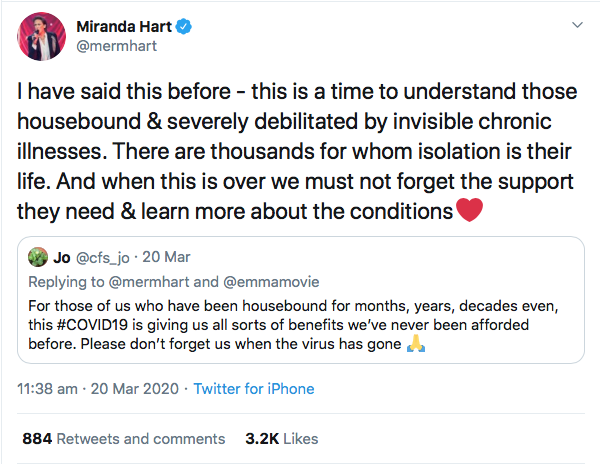
It’s hard to talk about positives related to the Coronavirus, because so much pain and suffering has come from it. But one positive thing the virus and the resulting lockdown have brought is that they have opened peoples’ eyes to the lives of those with disabilities and chronic illnesses. It’s something that Miranda Hart has spoken so eloquently about recently, both on Twitter and on Instagram. The last few months have given non-disabled people a rare insight into what it’s like to have a disability or chronic illness. Of course, it’s not the same. Although there’s uncertainty, there is the prospect of an end date one day with lockdown/the virus, which those with chronic illnesses and disabilities don’t have. But non-disabled people have, often for the first time, experienced how an illness can bring your whole world crashing down around you. They’ve experienced the grief of looked-forward-to plans being cancelled. The fear of seeing an illness, which is out of your control, impact on your ability to earn money and have a career. They’ve seen how hard it is to have to stay at home for most of the time, not able to go to work, to the shops, to socialise with friends or to even get medical care.


Of course, I wouldn’t wish these things on anyone and I certainly wouldn’t have wished for a global pandemic to make these things a reality for everyone. But that’s what’s happened, and I think it’s important that we as a society learn things from our experiences so we can make the world a better place for everyone. Over the course of lockdown, I’ve had people tell me that they had no idea being housebound was so hard. People have said that they didn’t realise until recently the grief that comes when an illness destroys every single part of your life. There have been conversations on social media about what it must be like to be housebound all the time. People have expressed how great all these new accessible measures are. But those conversations are already dwindling. 


Life is getting back to some sort of normality and people are already forgetting their experiences of being housebound. Working from home is becoming less straightforward and the expectation to be back there in person has returned. People aren’t so interested in video calls and virtual groups because they can meet people in person again. Attractions have stopped making virtual content accessible. Those who can’t leave the house are now expected to try and fight for online food deliveries and the phone has stopped ringing with people checking you’re coping OK at home. Most people are getting back to ‘normal’ and are leaving those with disabilities and chronic illnesses behind again. Now that the problem of being housebound isn’t affecting the majority, the drive for non-disabled people to fight for accessibility just isn’t there any more. And we desperately need healthy, non-disabled people to be fighting our corner and being an ally too. 


There is so much that the world could learn from the last few months that would really help those with disabilities and chronic illnesses. So if you’re reading this and wondering what you can do to help us and make the world more accessible, I thought I would list just a few things that you can do to become an ally to disabled and chronically ill people:


·      If you own a company or work in any kind of management role, look into ways that you can help to make working flexible. Obviously some roles don’t lend themselves to working from home, but you could also look at flexible hours or the option to work part-time. And there are many jobs that can be done from home, as the lockdown has shown us. Don’t automatically dismiss job candidates with disabilities or those who ask about adaptations. Talk to them and find out what would make it easier for them to work with you. We are disabled/chronically ill, but we also have so much to give if we are just given the right adaptations for our needs


·       If you have a friend or family member with a disability or chronic illness, please just remember them. I’ve lost count of the number of times someone has said to me, “Oh I didn’t invite you because I didn’t think you’d be able to come.” Please don’t make decisions for us. Invite us to social events and let us decide if we are well enough or if adaptations need to be made


·      If someone with a disability or chronic illness isn’t able to come out in person, look at ways you can adapt to still include them. Ask them if they’d like to chat on the phone or by video call. Is there a way they could get involved with something virtually? Could you perhaps organise some events, such as virtual quizzes or group video chats, that are accessible to them from the beginning? I think the biggest thing is just not to forget them just because they’re not there in person


·      If you work for an attraction (whether that’s a theme park, museum, zoo, gardens or anything else), try to continue with virtual content. Virtual tours or videos have allowed some disabled people to experience ‘going out’ for the first time, when ordinarily they would have no hope of being able to enjoy that attraction


·      Also look at ways the attraction can be made more accessible to those with disabilities/chronic illnesses that might be able to visit in person. Are there enough accessible toilets? Is information in an accessible format? Please actually speak to disabled people and get our views on accessibility measures, as we know what adaptations we need


·      If you work in the live entertainment industry (i.e. putting on musicals, plays, concerts and other live events) consider whether you can continue to provide video content that people can watch from home. During lockdown, some disabled people have been able to watch a West End Musical or enjoy a concert by their favourite musician/singer for the first time, and it’s been great! Accessibility can be a huge problem when it comes to live events and entertainment, so having the option to watch something from home, at a time that suits the individual, is invaluable. There’s no reason you can’t charge for this service either – I don’t think disabled people would expect to get this sort of content for free. So it’s another possible avenue for much-needed revenue, especially at the moment when entertainment venues are struggling so much, and makes live events inclusive for all


·      Although some disabled people may not be able to visit places like theatres or arenas, there are also a lot who can as long as the correct adaptations are in place. So please help disabled people to feel welcome by ensuring access is suitable for a whole range of needs (and again, please talk to us to find out what we actually need). For example, make sure the booking process is accessible, that there is enough accessible seating (both for those in wheelchairs and those who may not be able to walk far/climb stairs), that there are accessible toilets and that programmes are available in different formats


·      It would help a lot of people with disabilities and chronic illnesses if the NHS could continue to make greater use of virtual medical appointments. Obviously these aren’t suitable for all appointments – we will still need to visit hospitals for tests, treatments and appointments that require us to be examined or seen in person. And sometimes I quite appreciate being able to see a Doctor in person. But for a lot of appointments, talking on the phone or by video call would be absolutely fine. Virtual appointments would save us having to use limited energy to travel long distances, would mean we could save money on travel costs and parking and would also mean that those who are too unwell to leave the house can still access the medical care they so desperately need


·      I think it would be great if we continued to be more aware of those in our local community who might be housebound or who find it difficult to leave the house. In our community a series of Facebook groups have been set up so that those shielding could ask for help if they needed it. I would love to see these groups continue to be used once lockdown has eased, to try and continue to help those who might need it. But more than that, we need to be checking on our neighbours because not everyone will have social media. If everyone checked on the neighbours around them, then no one would have to face the world alone. So why not drop a note through your neighbours’ doors to let them know your details if they need anything. Get to know the people who live around you – sometimes disabled and chronically ill people may not need any practical help, but would just love some social contact


·      And in the wider society, it would be great to see a bit more focus on those with disabilities and chronic illnesses. I’ve seen a lot more articles written by disabled and chronically ill people during the pandemic because the media realised we have something to contribute on this particular issue. But this inclusion needs to continue – our experiences matter. And we don’t just have to contribute to disability and health related topics – we have other talents and views on a whole range of other things too!


I think the biggest thing society can do to be an ally to people with disabilities and chronic illnesses though, is to listen to us, include us and remember we exist. Please, if you take one thing away from lockdown, let it be an increased awareness of what it is like to live with a disability or chronic illness. This period of time has given everyone a unique insight, albeit only a brief glimpse, of what it is like to have restrictions placed on your life by uncontrollable health circumstances. You have experienced the fear and anxiety that comes from a medical condition, the grief that comes from having your plans cancelled and having no control over when you might be able to do things again and the overwhelming loneliness and isolation that comes from staying in your home for months on end.


So please, don’t forget how these experiences made you feel because that is just a tiny taster of what it can be like living with a disability or chronic illness. Use your increased knowledge to reach out to family and friends with disabilities and chronic illnesses. Find ways to do what you can to make the world more inclusive and accessible. Join disabled people in fighting for equality and respect. And above all, please, just don’t forget that there will still be many people living in lockdown when you go back to your normal life. 


Has lockdown helped you to understand a bit more of what it can be like living with a disability or chronic illness? Or as a disabled/chronically ill person, have you noticed any positive or negative changes as lockdown restrictions are being eased?


Tuesday, 26 February 2019

Rare Disease Day - Living with Ehlers-Danlos Syndrome

The 28th of February 2019 marks the twelfth international Rare Disease Day coordinated by EURORDIS. It’s a day when hundreds of patient organisations from all over the world hold activities to raise awareness amongst the general public and decision-makers about rare diseases and their impact on patients’ lives. 1 in 20 people will live with a rare disease at some point in their life, but despite this, there is no cure for the majority of rare diseases and many go undiagnosed for years or even a lifetime.


So what is a rare disease?

In Europe, a disease or disorder is defined as rare when it affects less than 1 in 2000 people. There are over 6000 rare diseases, which cause patients a huge range of symptoms. These can vary between disorders, but symptoms can also differ between those suffering from the same disease. Misdiagnosis in rare diseases is, unfortunately, common, and this can lead to a delay in treatment and therefore affect a person’s quality of life. And with so few cures available, patients with rare diseases often endure high levels of pain and suffering, alongside their families. This is why awareness and research is so important.

I was born with a rare disease (Hypermobile Ehlers-Danlos Syndrome), but didn’t receive a diagnosis until I was 25. That wait for answers isn’t uncommon and it left me struggling with my mental health as well as my physical health. So today, I thought I would use this opportunity to talk about what it’s like to live with Ehlers-Danlos Syndrome (EDS) in the hope it will help people to understand, to recognise the symptoms and to invest in further research towards treatment and ultimately a cure.


The symptoms of Hypermobile EDS

Hypermobile EDS is thought to be the most common genetic connective tissue disorder, although at the moment there is no up-to-date research that reveals how frequently it occurs. You can either inherit the disease from a parent who has the same faulty gene, or it can be caused by a mutation during conception, meaning no one else in the family has it.

There are a whole host of symptoms and associated conditions that come with Hypermobile EDS, including, but not limited to:
·     Joint Hypermobility
·     Chronic Pain
·     Joint dislocations and subluxations
·     Smooth, stretchy skin
·     Fragile skin that bruises easily
·     Fatigue
·     Digestive problems such as Gastroparesis and Intestinal Dysmotility
·     Postural Orthostatic Tachycardia Syndrome (POTS) – dizziness, fainting, increased heart rate (especially on standing up)
·     Problems with internal organs such as mitral valve prolapse or organ prolapses
·     Problems with the bladder e.g. incontinence or retention
·     Mast Cell Activation Disorder

What’s it like to live with Ehlers-Danlos Syndrome?

I sometimes find it quite difficult to describe what life is like with EDS because I’ve never known any different! I can often forget that some of the things I experience aren’t ‘normal’ – for example, I sometimes forget that it’s not usual to be in constant pain or to spend half your life at hospital appointments!


Growing up, I didn’t know I had Ehlers-Danlos Syndrome, but looking back I can see constant signs of it. As a baby, I needed to be fitted with a Pavlik Harness to stop my hips from dislocating. Thankfully, it’s not something I remember, but I know it made life more difficult for my parents, especially when it came to nappy changes and the fact I couldn’t have a proper bath! As I got older, I was always injuring myself and spent many an evening in A&E with sprains and strains (probably caused by partial dislocations, but I didn’t know that at the time).

It was only when I was 15 though, that my EDS started to have a noticeable affect on my life. And, as I mentioned, it took until I was 25, another ten years, to be given the correct diagnosis. It probably sounds obvious, but life with Ehlers-Danlos Syndrome is hard. I’ll often try to play it down to friends and family because I don’t want to worry them or be known as the person who is always complaining, but having a rare disease (or several!) is incredibly difficult and scary. 


The constant widespread pain and debilitating fatigue is completely draining, and some days I will wake up and wonder how on earth I’m going to make it through another day. Although I now know what is wrong with me, it doesn’t take away how frightening it can be when your body is malfunctioning and there’s very little anyone can do about it. A relatively new symptom to crop up is that I’ve been finding it difficult to swallow. Such a basic function that most people take for granted, but at the moment every mouthful brings with it gagging, coughing and food getting stuck in my throat. And it’s massively anxiety provoking; not quite understanding why something else is going wrong and wondering whether there will be a solution or whether it will be something else that I just need to ‘live with’.

Yes, the actual physical symptoms are tough to live with, especially when there’s no treatment, but it’s the anxiety that comes alongside living with a rare disease that can often go unappreciated by others. People (friends, acquaintances and even medical professionals) often expect me to be used to spending time at medical appointments, in hospital and having tests, so it can be hard for them to understand that, just because I’ve been doing those things for a long time, it doesn’t make them any less scary! I’ve had people say to me, “Oh, I thought you’d be used to having blood tests by now?!” And yes, I am ‘used’ to it in the sense that I’ve lost count of the amount I’ve had. But being used to having to do something regularly doesn’t mean I don’t still get anxious about it! And it doesn’t stop these tests and procedures from hurting and making me feel unwell.


Living with a rare disease like Ehlers-Danlos Syndrome is also incredibly frustrating for a number of reasons. For example, I have a brain that doesn’t quite realise that my body doesn’t work properly! So I have all these thoughts, hopes and dreams of doing all sorts of amazing things, but my body just won’t keep up! I try not to discount things that I want to do straight away, because with a lot of things there is a way around my disabilities. But there are dreams I’ve had to give up on, such as becoming a Doctor, simply because my health isn’t good enough. And that really sucks! 

It’s also incredibly frustrating to have a disease that has very little treatment and no cure. I’ve had to lower my expectations dramatically from when I first got really unwell. At the age of 15, when my health began to fail, I would go to the doctors with the expectation of getting a diagnosis and some treatment to eventually feel better. But over the years, and since getting my EDS diagnosis, I’ve had to adjust my expectations of what the medical profession can do for me. I now know that I have a condition (and associated conditions) that are not well understood and have very few treatment options. I know that generally, when I go and see a doctor for a specific set of symptoms, the response is more than likely going to be that it’s something I will have to learn to live with and manage. I’m very much the kind of person who likes to fix something if it’s not working, so having a body that doesn’t work in that way is challenging to say the least!


Alongside this, living with a rare disease can feel incredibly lonely. If you have a fairly common chronic condition, the likelihood is that there will be a specific department at your local hospital that treats/manages this condition. There will be consultants who specialise in it, specialist nurses that you can contact if you need advice and possibly a local support group so you can talk to others going through similar problems. But for rare diseases, most of these things just don’t exist. I’ve been passed from pillar to post around my local hospital as doctors have tried to work out who would be best to look after me. These days, I usually end up being referred to specialists up in London (which is exhausting in it’s own right, although I am grateful to have their input) but even they don’t usually specialise in my particular disease – they tend to focus on a specific symptom/set of symptoms but not necessarily related to Ehlers-Danlos Syndrome. I don’t have any kind of specialist nurse as my first point of contact if things get worse or I need some help. And if I try to ring my local surgery or a secretary of one of my consultants, they are often at a loss of what to do with me because they don’t have knowledge of my rare disease. 

Thankfully there is a charity, EDS UK, who do all that they can for people with EDS – without them, it would be an even lonelier existence. I’ve reached out to them before when I’ve needed support or advice and I often read their latest research and attempts to make life better for people with EDS. They also run local support groups both on Facebook and in person, and so this does help to break to isolation that a rare disease can bring. I’ve lost a lot of friends over the years because of my illnesses – either they’ve drifted away because I can’t do the things they want to do or they haven’t understood my conditions – and it’s heart breaking. And it’s not that easy to make new friends because my poor health makes it difficult to get out and about as much as I’d like. I’m a naturally sociable person, so to be in a position where I have so little social contact has a massive affect on my mental health.


So as you can probably see, life with a rare disease is complicated. I did consider basing this post around the individual symptoms that I experience as part of my EDS and how they affect my daily life, but decided I wanted to speak about life with EDS more generally. However, if you would be interested to hear more about the symptoms I experience and ways I try and manage them, I would be happy to do another post around those issues, so do let me know.


My hope is that, with this post, I will help to raise awareness of rare diseases, Ehlers-Danlos Syndrome and what life is like when you have something ‘different’. In the future I would love to see more being done for the 1 in 20 of us who will have a rare disease at some point in our life. Whether that’s research into treatments and cures or just more support on offer to help people live with these often-incurable conditions. I hope that one day, having a rare disease won’t be such a lonely experience and that, one day, people won’t have to fight for years just to be listened to and to receive a diagnosis.

Do you have a rare disease? Or can you relate to anything I’ve spoken about in this post?