The last few weeks have seen pretty huge changes in the UK as lockdown measures have started to ease. More children are back at school, more people are going into work, non-essential shops are re-opening, you can enjoy a drink at the pub or go to get your hair cut and people are now allowed to visit zoos, the seaside, their family. You could be forgiven for thinking life is going back to ‘normal’ (although we are far from normal yet with the virus still spreading). But not everyone is escaping the lockdown restrictions. There are a group of people for whom lockdown will continue long after we get on top of this virus – those who live with disabilities and/or chronic illnesses.

For us, lockdown didn’t start on the 23rd March 2020. Some of us have been living in lockdown for months or even years already. My ‘lockdown’ began at the age of 15, when I became really unwell with what we originally thought was ‘just’ M.E. Over the years though, the M.E. diagnosis has been added to and I now know that I also have a whole collection of chronic illnesses including Ehlers-Danlos Syndrome, Postural Orthostatic Tachycardia Syndrome, Gastroparesis, Bladder Dysfunction, Mast Cell Activation Syndrome and a few more problems thrown in for good measure. I’ve spent much of my life unable to leave the house (and sometimes even unable to leave my bed). I’m ‘lucky’ at the moment – if I need to, I can leave the house for a medical appointment or the odd ‘nice’ thing. But I’ve been through many a period where even getting to an essential medical appointment has been impossible. And I have friends who have spent years trapped in their homes because they’re simply too unwell to even get down the stairs.
When lockdown was first implemented, there were a lot of conversations on social media about how awful it was going to be to have to stay at home for the majority of the time, or to even have to self-isolate completely for two weeks if there was a possibility of having the virus. People spoke about how upset they were that their plans had been cancelled, they were worried about their jobs, holidays weren’t going to happen and people were concerned that there was no end date in sight. These are all completely valid concerns for anyone to have. But I know to begin with, a lot people in the chronic illness and disability communities (myself included), found these conversations really hard to hear. We have spent large chunks of our lives being hidden away from the world, forgotten because we are behind closed doors. We have had to grieve for the lives we have lost, the careers that have been abruptly ended, the plans that may never be able to happen. This is our reality. So to hear everyone suddenly discussing how awful it was going to be, when we have been dealing with it alone for so many years, was really hard to get your head around.

But as time went on, things changed a bit. The world started to become a bit more accessible. Working from home and in a flexible way became the norm. People started utilising facilities for virtual meetings. Friends used video calls to keep in touch. Suddenly virtual parties and quizzes became the way people chose to socialise. Attractions quickly started to provide online content so they could still be experienced without having to go there in person. It was soon possible to watch a West End musical or play from the comfort of your own home. Medical appointments were offered via video call, rather than having to travel miles to be seen in person. Communities came together to ensure those who couldn’t leave the house were given food deliveries, medication and phone calls to check they were OK. Articles were written and videos were made about how to support each other while we had to stay at home.
The world actually started to care about people who couldn’t leave the house because it was something that was affecting healthy, non-disabled people. Accessibility options and adaptations that the disabled and chronic illness communities have been fighting for for years were brought in overnight. After spending years being told we couldn’t work from home or that we would have to miss out if we couldn’t get somewhere in person, these things quickly became possible when the rest of the world realised they didn’t want to lose out. And to be totally honest, it really hurt to see how easily these measures could be put in place if people just tried.

It’s hard to talk about positives related to the Coronavirus, because so much pain and suffering has come from it. But one positive thing the virus and the resulting lockdown have brought is that they have opened peoples’ eyes to the lives of those with disabilities and chronic illnesses. It’s something that Miranda Hart has spoken so eloquently about recently, both on Twitter and on Instagram. The last few months have given non-disabled people a rare insight into what it’s like to have a disability or chronic illness. Of course, it’s not the same. Although there’s uncertainty, there is the prospect of an end date one day with lockdown/the virus, which those with chronic illnesses and disabilities don’t have. But non-disabled people have, often for the first time, experienced how an illness can bring your whole world crashing down around you. They’ve experienced the grief of looked-forward-to plans being cancelled. The fear of seeing an illness, which is out of your control, impact on your ability to earn money and have a career. They’ve seen how hard it is to have to stay at home for most of the time, not able to go to work, to the shops, to socialise with friends or to even get medical care.
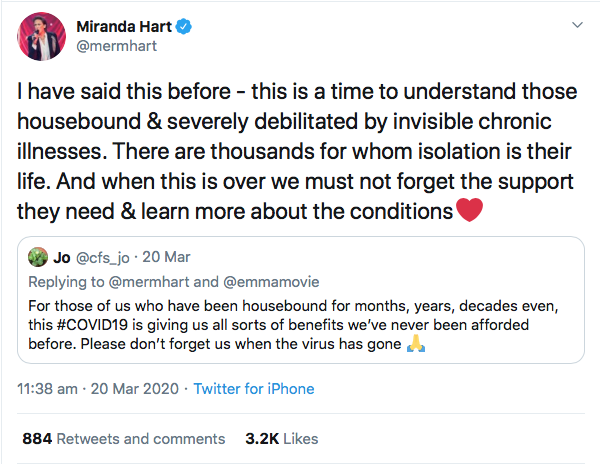
Of course, I wouldn’t wish these things on anyone and I certainly wouldn’t have wished for a global pandemic to make these things a reality for everyone. But that’s what’s happened, and I think it’s important that we as a society learn things from our experiences so we can make the world a better place for everyone. Over the course of lockdown, I’ve had people tell me that they had no idea being housebound was so hard. People have said that they didn’t realise until recently the grief that comes when an illness destroys every single part of your life. There have been conversations on social media about what it must be like to be housebound all the time. People have expressed how great all these new accessible measures are. But those conversations are already dwindling.
Life is getting back to some sort of normality and people are already forgetting their experiences of being housebound. Working from home is becoming less straightforward and the expectation to be back there in person has returned. People aren’t so interested in video calls and virtual groups because they can meet people in person again. Attractions have stopped making virtual content accessible. Those who can’t leave the house are now expected to try and fight for online food deliveries and the phone has stopped ringing with people checking you’re coping OK at home. Most people are getting back to ‘normal’ and are leaving those with disabilities and chronic illnesses behind again. Now that the problem of being housebound isn’t affecting the majority, the drive for non-disabled people to fight for accessibility just isn’t there any more. And we desperately need healthy, non-disabled people to be fighting our corner and being an ally too.

There is so much that the world could learn from the last few months that would really help those with disabilities and chronic illnesses. So if you’re reading this and wondering what you can do to help us and make the world more accessible, I thought I would list just a few things that you can do to become an ally to disabled and chronically ill people:
· If you own a company or work in any kind of management role, look into ways that you can help to make working flexible. Obviously some roles don’t lend themselves to working from home, but you could also look at flexible hours or the option to work part-time. And there are many jobs that can be done from home, as the lockdown has shown us. Don’t automatically dismiss job candidates with disabilities or those who ask about adaptations. Talk to them and find out what would make it easier for them to work with you. We are disabled/chronically ill, but we also have so much to give if we are just given the right adaptations for our needs
· If you have a friend or family member with a disability or chronic illness, please just remember them. I’ve lost count of the number of times someone has said to me, “Oh I didn’t invite you because I didn’t think you’d be able to come.” Please don’t make decisions for us. Invite us to social events and let us decide if we are well enough or if adaptations need to be made
· If someone with a disability or chronic illness isn’t able to come out in person, look at ways you can adapt to still include them. Ask them if they’d like to chat on the phone or by video call. Is there a way they could get involved with something virtually? Could you perhaps organise some events, such as virtual quizzes or group video chats, that are accessible to them from the beginning? I think the biggest thing is just not to forget them just because they’re not there in person
· If you work for an attraction (whether that’s a theme park, museum, zoo, gardens or anything else), try to continue with virtual content. Virtual tours or videos have allowed some disabled people to experience ‘going out’ for the first time, when ordinarily they would have no hope of being able to enjoy that attraction
· Also look at ways the attraction can be made more accessible to those with disabilities/chronic illnesses that might be able to visit in person. Are there enough accessible toilets? Is information in an accessible format? Please actually speak to disabled people and get our views on accessibility measures, as we know what adaptations we need
· If you work in the live entertainment industry (i.e. putting on musicals, plays, concerts and other live events) consider whether you can continue to provide video content that people can watch from home. During lockdown, some disabled people have been able to watch a West End Musical or enjoy a concert by their favourite musician/singer for the first time, and it’s been great! Accessibility can be a huge problem when it comes to live events and entertainment, so having the option to watch something from home, at a time that suits the individual, is invaluable. There’s no reason you can’t charge for this service either – I don’t think disabled people would expect to get this sort of content for free. So it’s another possible avenue for much-needed revenue, especially at the moment when entertainment venues are struggling so much, and makes live events inclusive for all
· Although some disabled people may not be able to visit places like theatres or arenas, there are also a lot who can as long as the correct adaptations are in place. So please help disabled people to feel welcome by ensuring access is suitable for a whole range of needs (and again, please talk to us to find out what we actually need). For example, make sure the booking process is accessible, that there is enough accessible seating (both for those in wheelchairs and those who may not be able to walk far/climb stairs), that there are accessible toilets and that programmes are available in different formats
· It would help a lot of people with disabilities and chronic illnesses if the NHS could continue to make greater use of virtual medical appointments. Obviously these aren’t suitable for all appointments – we will still need to visit hospitals for tests, treatments and appointments that require us to be examined or seen in person. And sometimes I quite appreciate being able to see a Doctor in person. But for a lot of appointments, talking on the phone or by video call would be absolutely fine. Virtual appointments would save us having to use limited energy to travel long distances, would mean we could save money on travel costs and parking and would also mean that those who are too unwell to leave the house can still access the medical care they so desperately need
· I think it would be great if we continued to be more aware of those in our local community who might be housebound or who find it difficult to leave the house. In our community a series of Facebook groups have been set up so that those shielding could ask for help if they needed it. I would love to see these groups continue to be used once lockdown has eased, to try and continue to help those who might need it. But more than that, we need to be checking on our neighbours because not everyone will have social media. If everyone checked on the neighbours around them, then no one would have to face the world alone. So why not drop a note through your neighbours’ doors to let them know your details if they need anything. Get to know the people who live around you – sometimes disabled and chronically ill people may not need any practical help, but would just love some social contact
· And in the wider society, it would be great to see a bit more focus on those with disabilities and chronic illnesses. I’ve seen a lot more articles written by disabled and chronically ill people during the pandemic because the media realised we have something to contribute on this particular issue. But this inclusion needs to continue – our experiences matter. And we don’t just have to contribute to disability and health related topics – we have other talents and views on a whole range of other things too!
I think the biggest thing society can do to be an ally to people with disabilities and chronic illnesses though, is to listen to us, include us and remember we exist. Please, if you take one thing away from lockdown, let it be an increased awareness of what it is like to live with a disability or chronic illness. This period of time has given everyone a unique insight, albeit only a brief glimpse, of what it is like to have restrictions placed on your life by uncontrollable health circumstances. You have experienced the fear and anxiety that comes from a medical condition, the grief that comes from having your plans cancelled and having no control over when you might be able to do things again and the overwhelming loneliness and isolation that comes from staying in your home for months on end.

So please, don’t forget how these experiences made you feel because that is just a tiny taster of what it can be like living with a disability or chronic illness. Use your increased knowledge to reach out to family and friends with disabilities and chronic illnesses. Find ways to do what you can to make the world more inclusive and accessible. Join disabled people in fighting for equality and respect. And above all, please, just don’t forget that there will still be many people living in lockdown when you go back to your normal life.

Has lockdown helped you to understand a bit more of what it can be like living with a disability or chronic illness? Or as a disabled/chronically ill person, have you noticed any positive or negative changes as lockdown restrictions are being eased?


