Showing posts with label Accessibility. Show all posts

Friday, 5 February 2021

Reflecting on 2020 and my Goals for 2021

It’s hard to know how to start this post after not updating my blog in so long, so I think I’ll just start by saying ‘hello’ again! Being quiet on here since July hasn’t been deliberate. I’ve desperately wanted to share posts and have a growing list of ideas of things I’d like to write about. I’ve just struggled to actually do it! A mixture of my health being decidedly rubbish since my major surgery in November 2019 and a global pandemic affecting both my physical and mental health haven’t made for a very productive Jenny. But one of my goals for 2021 (more on those later) is to really try and start getting some content out on here again, even if it’s just writing little bits here and there. So here I am with my first post of the year! And I thought a good place to start would be to just reflect a bit on the past year and then look forward to the year ahead.


Reflecting on 2020


Where do I even start with reflecting on the last year?! It’s certainly been a strange and scary one for most of us hasn’t it? I started 2020 having just had major leg surgery (a Femoral Osteotomy). I was spending the majority of my time sleeping, keeping dosed up on various painkillers and having regular physiotherapy. I saw 2020 as my year to recover – to gain strength, increase my mobility and to start doing some of the things I enjoy again as I started to get better. But I hadn’t planned for two things – one, that complications from surgery would make recovery increasingly difficult and two, that we would be plunged into a global pandemic. 


I always knew that the surgery came with risks (with added risks on top because of my Ehlers-Danlos Syndrome). But I think when you go in for any kind of surgery, you convince yourself that you will dodge these risks and that things will go smoothly – otherwise you wouldn’t go ahead with the surgery! And a lot of the time, things do go to plan. You have your surgery, it resolves the problem, you make a good recovery and generally your life is better for having that intervention. But occasionally, things aren’t quite so straightforward. And this seems to have been the case for me this time. 


The place where they broke my femur has actually been healing quite nicely (albeit rather slowly). But unfortunately, the surgery has affected my knee and nobody seems to know why. As the months have gone on, I’ve been struggling to bend my knee, have been getting a lot of pain and swelling in it and have been finding it hard to put much weight through my leg because of this. It’s been incredibly frustrating, especially as my mobility is now worse than it was before I had the surgery (which definitely wasn’t the plan – it was meant to try and improve it!) 


And unfortunately a global pandemic hasn’t helped matters, as it meant my physiotherapy had to stop and I struggled to get appointments with my surgeon. When I did eventually manage to see my surgeon in person, he let me know that because my appointment (and possible treatment) had been delayed due to Covid, there is a very real possibility that I may never regain the full use of my leg again. Devastated is definitely an understatement! I don’t blame my surgeon – he’s just as frustrated by the situation as I am and it’s not his fault we’re in a global pandemic. But I am obviously angry and upset at Covid for potentially losing me the full use of my right leg. 


I’m trying to stay as positive as I can in the hope my surgeon can find an answer and that I will see some improvement. But it’s not easy, especially when it’s still so difficult to access services because of the strain of the pandemic.


And that brings me on to the second significant thing that happened in 2020 – Coronavirus. It’s obviously been a difficult time for everyone, although we have all been affected in slightly different ways and perhaps some more negatively than others. I can only really talk about the effect it’s had on me and my loved ones, but I don’t want to dismiss the fact it’s impacted each and every one of us and that some people are struggling a lot more than others. 


For me, in some ways, I guess I’ve been kind of lucky in a strange, roundabout kind of way. Having been chronically ill for the last 17 years, often spending large parts of my time housebound, being put into Lockdown wasn’t a huge shock for me. Chronic illness had prepared me pretty well for not being able to leave the house. So while a lot of the world struggled to come to terms with staying at home for months on end, the chronic illness community didn’t see our day-to-day lives change particularly. 


Don’t get me wrong – it was really hard to suddenly hear everyone complaining about being ‘stuck’ at home, telling everyone that they didn’t know how they were expected to live like this for so long. It was strange to suddenly be surrounded by people living a life that you have lived for so many years without any recognition. All of a sudden things started to be made available to people who couldn’t leave the house. It was possible to work from home, medical appointments could be done via video call, virtual tours were made available for museums and gardens and communities came together to ensure those who were housebound had access to food, medication and company. 


For a lot of the chronic illness and Disabled community, these changes were a double-edged sword. In some ways it felt really great to see the wider world being made accessible for the first time. I have friends who were finally able to speak to a doctor after struggling alone for years because they weren’t well enough to get to a physical appointment. But it was also incredibly frustrating and hurtful to see these adaptations be put in place with such ease and speed. We have been asking for them for years and have either been ignored, or been told it simply isn’t possible. Imagine developing a chronic illness, asking your work if they will facilitate working from home to enable you to still do your job and then having to leave when they tell you that the job can’t be done from home. And then, to add insult to injury, someone else is given your job and is then given the adaptations needed to do the job from home. It was possible all along, but only when a situation arose that affected non-disabled people. 


I think the way Disabled people have been treated over the last year is one of the things that has affected me most during the pandemic (other than losing the majority of my medical care and the fear of myself and my loved ones getting the virus). I’ve been well aware of ableism growing up, having been Disabled since I was 15. But over the last year it has become so overwhelming that it’s been difficult to escape, even in the safety of my own home. 


Constant comments on social media like “Only the elderly and vulnerable will die,” “the vulnerable should just stay inside so the rest of us can get on with our lives,” “the vulnerable should take responsibility and protect themselves – it’s not our job to mollycoddle them” and “why should the majority suffer to protect the few” have been hard to ignore. 


Finally being able to leave the house and finding Disabled parking bays have been turned into queuing areas or toilets have been closed has made it even harder for Disabled people to access the world. And knowing that, in the first half of 2020, 59% of all deaths involving Covid-19 were among disabled people was terrifying to hear. 


This year, it’s just felt like things have gone backwards with our society’s attitudes towards Disabled people, and it’s been really sad (and quite scary) to witness. I know a lot of Disabled people have found this has taken a toll on their mental health (myself included). So I hope anyone who is reading this that has been affected in a similar way is doing as OK as possible at the moment. It hasn’t been easy (and it’s hard to see things improving any time soon) but you’re doing an amazing job simply getting from one day to the next, so please don’t be too hard on yourself. Apart from my family and friends, the one thing that has kept me sane over the last year is the amazing Disabled community I have found on social media. Perhaps I’ll do a blog post at some point sharing some of my favourite accounts, as feeling a part of a community who are fighting back, showing that being Disabled isn’t a negative thing and supporting each other through this has been a real lifesaver. 


Goals for 2021


So moving onto this year – I often find it quite difficult to set New Year’s Resolutions and goals to be honest. Being chronically ill, life can be pretty unpredictable and so it can get quite demoralising setting goals and then finding my health just won’t allow me to achieve them. Add into the mix a global pandemic, and it almost feels impossible to look ahead and find things to aim for that I know will be achievable. However, I do think setting myself targets is important, as it helps me to have positive things to focus on and gives me some motivation on those days where it’s seriously lacking! So this year, I’ve tried to set myself goals that I should be able to achieve regardless of what’s happening with the pandemic (and my health to a lesser extent). I’ve tried to focus more on self-care – doing things that I know will help me to feel a bit better physically and mentally – because I think that’s what I need right now. I thought I’d share them with you, partly to give myself some accountability, but also just in case it helps anyone else who’s trying to set goals but doesn’t know where to start. So, my goals/resolutions for 2021 are:


Go to bed earlier


I’ve always been a night owl, but since the pandemic hit, I’ve got into a really bad routine of going to bed far too late. In some ways it does work for me (I guess that’s why we get into bad habits, because they do serve a purpose, even if it’s not in the best way) but I also know that it’s not the best routine to be in because it leads to me getting up a lot later in the morning and generally just feeling pretty groggy. So I really want to get myself into a better routine of going to bed a bit earlier. I’m not saying I’ll be in bed by 10pm, as that just isn’t how my body works, but I do want to gradually bring my bedtime forward until I get to a place that feels right for me. And I’m hoping it will bring the added bonus of giving me a bit of time to start reading again before I fall asleep because at the moment, I’m just too tired to even try.


Get back to doing my skincare routine


I used to religiously follow a skincare routine of cleansing, toning and moisturising every day. But when I had my leg surgery, it kind of went out the window a bit and for some reason, I’ve really struggled to get back into doing it. I think part of the reason is because I’ve felt so rubbish since having my operation – I just haven’t really felt like doing anything nice for myself, partly through feeling physically unwell and partly through my mental health not being great. And this is something I want to work on because I know spending a few minutes each day giving myself some simple pampering can make a big impact on how I feel. Even if I start with something very simple – like putting a bit of moisturiser on – I want to get back into consistently making time to look after my skin.


Post on my blog more


So as I mentioned at the beginning of this post, things were pretty quiet on my blog during 2020. And it’s something I really want to change. My blog is where I first started creating content before I expanded to Instagram and YouTube, so it holds a special place in my heart. I love writing and taking photos – it just ended up falling by the wayside a bit recently as my energy was being used for other things. I don’t want to compromise on creating content for my other platforms, so I need to try and manage my time a bit better so I can start getting some more posts on here. Apart from my energy levels, I think one thing that continually stops me posting on here is not feeling like my work is good enough. Comparing my photos to other bloggers who take the most beautiful pictures, doubting myself over whether I have something interesting or useful to say and worrying that, because I can’t get out much, what I post won’t be interesting enough – I’m constantly telling myself that there’s no point in trying because it won’t match up to what other people are doing. But the more I think about it, the more I realise how ridiculous that all sounds. I follow a whole variety of content creators and the things that they post are so diverse, and that’s why I like them. And even if no one wants to read my ramblings, I enjoy writing them and taking the photos, so I think that’s the most important thing to focus on. 


Be open-minded about treatment for my leg


As I’ve talked about in this post, my post-surgery recovery from my Femoral Osteotomy has not been going to plan. To begin with, I was quite fixed with my ideas of what was causing the problems (I thought it was all down to the rotation issues with my lower leg, and believed that by having that corrected, everything would be fixed). But, with the help of my surgeon and other medical professionals, I’m starting to realise that it probably isn’t as ‘simple’ as that, and it may be a case of a number of problems going on that we have to deal with (i.e. muscle and nerve problems too). Because of this, I feel like I need to try and be a bit more open-minded about possible treatments I’m being offered. It’s not discounting that I’m likely to need further surgery at some point to correct the misalignment in my lower leg (and possibly sorting out my other leg at some point!), but just recognising that it’s probably not a straightforward issue and that I may have to have other treatments to get me to a place where surgery can be considered. 


Less mindless scrolling


It’s only fairly recently that I’ve realised just how much time I spend scrolling through social media on my phone and how much of a negative effect this has on my mental health. I definitely think it’s got worse since Covid came along – perhaps because there’s a bit more time, but also because I think I’ve got a bit drawn into reading comments on news articles on Facebook, which really isn’t good for my mood and anxiety levels! I have a bit of a love/hate relationship with social media – in some ways, I find it completely draining, while in other ways, I find it a great place to keep in touch with friends and to feel part of an amazing community of disabled and chronically ill people. So I guess I just want to make sure I’m using it more mindfully, in ways that make me feel good. I’ve already decided not to look at Facebook before I go to bed because I know it just triggers my anxiety and doesn’t help my brain to wind down. And instead of just scrolling and scrolling, I want to use the time I’m on social media to create more content, reply to more messages/comments and interact with users who make me feel happy and empowered. 


Be kind to myself


This last resolution is probably my most important one, but is also the one I know I’m going to find the hardest. I’ve never been very good at being kind to myself. It’s a major underlying theme of my mental health problems and I can trace it right back to my childhood. But I know it needs to change if I want to keep as well as possible. I know it’s a bit non-specific, but that’s kind of deliberate, as if I make it really specific, it will just be another thing I can use to berate myself when I don’t achieve it. I’d rather see it as an overarching theme, rather than a set goal. It could include things like not giving myself a hard time if I have a day where I don’t achieve one of my goals, letting myself start the next day afresh, cutting myself some slack when I’ve felt too exhausted/unwell to do anything but get out of bed and eat. There’s a never-ending list of little things I can do to just be a bit kinder to myself, so I just want to try and be more conscious of my thoughts and actions towards myself and to continually question whether I would treat a friend the way I’m treating myself. I’ve got a long way to go to get to a place where I accept and even love myself, but starting small and making the first step is the only way to start.


How did you cope with 2020? Do you have any goals for the year ahead? And do you have any advice that might help me with mine? 


Sunday, 12 July 2020

As Lockdown eases, please remember those of us who continue to live in Lockdown

The last few weeks have seen pretty huge changes in the UK as lockdown measures have started to ease. More children are back at school, more people are going into work, non-essential shops are re-opening, you can enjoy a drink at the pub or go to get your hair cut and people are now allowed to visit zoos, the seaside, their family. You could be forgiven for thinking life is going back to ‘normal’ (although we are far from normal yet with the virus still spreading). But not everyone is escaping the lockdown restrictions. There are a group of people for whom lockdown will continue long after we get on top of this virus – those who live with disabilities and/or chronic illnesses. 


For us, lockdown didn’t start on the 23rd March 2020. Some of us have been living in lockdown for months or even years already. My ‘lockdown’ began at the age of 15, when I became really unwell with what we originally thought was ‘just’ M.E. Over the years though, the M.E. diagnosis has been added to and I now know that I also have a whole collection of chronic illnesses including Ehlers-Danlos Syndrome, Postural Orthostatic Tachycardia Syndrome, Gastroparesis, Bladder Dysfunction, Mast Cell Activation Syndrome and a few more problems thrown in for good measure. I’ve spent much of my life unable to leave the house (and sometimes even unable to leave my bed). I’m ‘lucky’ at the moment – if I need to, I can leave the house for a medical appointment or the odd ‘nice’ thing. But I’ve been through many a period where even getting to an essential medical appointment has been impossible. And I have friends who have spent years trapped in their homes because they’re simply too unwell to even get down the stairs. 


When lockdown was first implemented, there were a lot of conversations on social media about how awful it was going to be to have to stay at home for the majority of the time, or to even have to self-isolate completely for two weeks if there was a possibility of having the virus. People spoke about how upset they were that their plans had been cancelled, they were worried about their jobs, holidays weren’t going to happen and people were concerned that there was no end date in sight. These are all completely valid concerns for anyone to have. But I know to begin with, a lot people in the chronic illness and disability communities (myself included), found these conversations really hard to hear. We have spent large chunks of our lives being hidden away from the world, forgotten because we are behind closed doors. We have had to grieve for the lives we have lost, the careers that have been abruptly ended, the plans that may never be able to happen. This is our reality. So to hear everyone suddenly discussing how awful it was going to be, when we have been dealing with it alone for so many years, was really hard to get your head around. 


But as time went on, things changed a bit. The world started to become a bit more accessible. Working from home and in a flexible way became the norm. People started utilising facilities for virtual meetings. Friends used video calls to keep in touch. Suddenly virtual parties and quizzes became the way people chose to socialise. Attractions quickly started to provide online content so they could still be experienced without having to go there in person. It was soon possible to watch a West End musical or play from the comfort of your own home. Medical appointments were offered via video call, rather than having to travel miles to be seen in person. Communities came together to ensure those who couldn’t leave the house were given food deliveries, medication and phone calls to check they were OK. Articles were written and videos were made about how to support each other while we had to stay at home. 


The world actually started to care about people who couldn’t leave the house because it was something that was affecting healthy, non-disabled people. Accessibility options and adaptations that the disabled and chronic illness communities have been fighting for for years were brought in overnight. After spending years being told we couldn’t work from home or that we would have to miss out if we couldn’t get somewhere in person, these things quickly became possible when the rest of the world realised they didn’t want to lose out. And to be totally honest, it really hurt to see how easily these measures could be put in place if people just tried. 


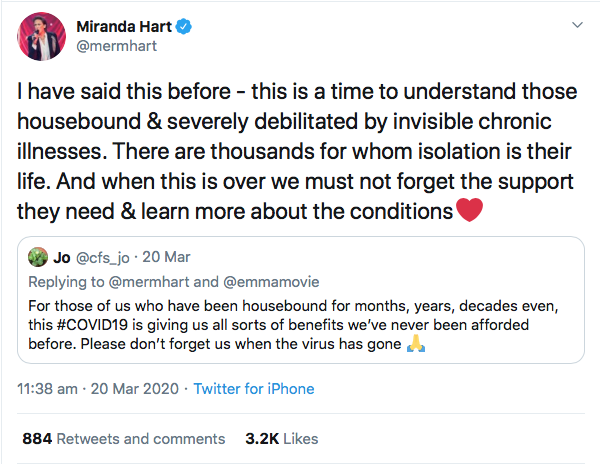
It’s hard to talk about positives related to the Coronavirus, because so much pain and suffering has come from it. But one positive thing the virus and the resulting lockdown have brought is that they have opened peoples’ eyes to the lives of those with disabilities and chronic illnesses. It’s something that Miranda Hart has spoken so eloquently about recently, both on Twitter and on Instagram. The last few months have given non-disabled people a rare insight into what it’s like to have a disability or chronic illness. Of course, it’s not the same. Although there’s uncertainty, there is the prospect of an end date one day with lockdown/the virus, which those with chronic illnesses and disabilities don’t have. But non-disabled people have, often for the first time, experienced how an illness can bring your whole world crashing down around you. They’ve experienced the grief of looked-forward-to plans being cancelled. The fear of seeing an illness, which is out of your control, impact on your ability to earn money and have a career. They’ve seen how hard it is to have to stay at home for most of the time, not able to go to work, to the shops, to socialise with friends or to even get medical care.


Of course, I wouldn’t wish these things on anyone and I certainly wouldn’t have wished for a global pandemic to make these things a reality for everyone. But that’s what’s happened, and I think it’s important that we as a society learn things from our experiences so we can make the world a better place for everyone. Over the course of lockdown, I’ve had people tell me that they had no idea being housebound was so hard. People have said that they didn’t realise until recently the grief that comes when an illness destroys every single part of your life. There have been conversations on social media about what it must be like to be housebound all the time. People have expressed how great all these new accessible measures are. But those conversations are already dwindling. 


Life is getting back to some sort of normality and people are already forgetting their experiences of being housebound. Working from home is becoming less straightforward and the expectation to be back there in person has returned. People aren’t so interested in video calls and virtual groups because they can meet people in person again. Attractions have stopped making virtual content accessible. Those who can’t leave the house are now expected to try and fight for online food deliveries and the phone has stopped ringing with people checking you’re coping OK at home. Most people are getting back to ‘normal’ and are leaving those with disabilities and chronic illnesses behind again. Now that the problem of being housebound isn’t affecting the majority, the drive for non-disabled people to fight for accessibility just isn’t there any more. And we desperately need healthy, non-disabled people to be fighting our corner and being an ally too. 


There is so much that the world could learn from the last few months that would really help those with disabilities and chronic illnesses. So if you’re reading this and wondering what you can do to help us and make the world more accessible, I thought I would list just a few things that you can do to become an ally to disabled and chronically ill people:


·      If you own a company or work in any kind of management role, look into ways that you can help to make working flexible. Obviously some roles don’t lend themselves to working from home, but you could also look at flexible hours or the option to work part-time. And there are many jobs that can be done from home, as the lockdown has shown us. Don’t automatically dismiss job candidates with disabilities or those who ask about adaptations. Talk to them and find out what would make it easier for them to work with you. We are disabled/chronically ill, but we also have so much to give if we are just given the right adaptations for our needs


·       If you have a friend or family member with a disability or chronic illness, please just remember them. I’ve lost count of the number of times someone has said to me, “Oh I didn’t invite you because I didn’t think you’d be able to come.” Please don’t make decisions for us. Invite us to social events and let us decide if we are well enough or if adaptations need to be made


·      If someone with a disability or chronic illness isn’t able to come out in person, look at ways you can adapt to still include them. Ask them if they’d like to chat on the phone or by video call. Is there a way they could get involved with something virtually? Could you perhaps organise some events, such as virtual quizzes or group video chats, that are accessible to them from the beginning? I think the biggest thing is just not to forget them just because they’re not there in person


·      If you work for an attraction (whether that’s a theme park, museum, zoo, gardens or anything else), try to continue with virtual content. Virtual tours or videos have allowed some disabled people to experience ‘going out’ for the first time, when ordinarily they would have no hope of being able to enjoy that attraction


·      Also look at ways the attraction can be made more accessible to those with disabilities/chronic illnesses that might be able to visit in person. Are there enough accessible toilets? Is information in an accessible format? Please actually speak to disabled people and get our views on accessibility measures, as we know what adaptations we need


·      If you work in the live entertainment industry (i.e. putting on musicals, plays, concerts and other live events) consider whether you can continue to provide video content that people can watch from home. During lockdown, some disabled people have been able to watch a West End Musical or enjoy a concert by their favourite musician/singer for the first time, and it’s been great! Accessibility can be a huge problem when it comes to live events and entertainment, so having the option to watch something from home, at a time that suits the individual, is invaluable. There’s no reason you can’t charge for this service either – I don’t think disabled people would expect to get this sort of content for free. So it’s another possible avenue for much-needed revenue, especially at the moment when entertainment venues are struggling so much, and makes live events inclusive for all


·      Although some disabled people may not be able to visit places like theatres or arenas, there are also a lot who can as long as the correct adaptations are in place. So please help disabled people to feel welcome by ensuring access is suitable for a whole range of needs (and again, please talk to us to find out what we actually need). For example, make sure the booking process is accessible, that there is enough accessible seating (both for those in wheelchairs and those who may not be able to walk far/climb stairs), that there are accessible toilets and that programmes are available in different formats


·      It would help a lot of people with disabilities and chronic illnesses if the NHS could continue to make greater use of virtual medical appointments. Obviously these aren’t suitable for all appointments – we will still need to visit hospitals for tests, treatments and appointments that require us to be examined or seen in person. And sometimes I quite appreciate being able to see a Doctor in person. But for a lot of appointments, talking on the phone or by video call would be absolutely fine. Virtual appointments would save us having to use limited energy to travel long distances, would mean we could save money on travel costs and parking and would also mean that those who are too unwell to leave the house can still access the medical care they so desperately need


·      I think it would be great if we continued to be more aware of those in our local community who might be housebound or who find it difficult to leave the house. In our community a series of Facebook groups have been set up so that those shielding could ask for help if they needed it. I would love to see these groups continue to be used once lockdown has eased, to try and continue to help those who might need it. But more than that, we need to be checking on our neighbours because not everyone will have social media. If everyone checked on the neighbours around them, then no one would have to face the world alone. So why not drop a note through your neighbours’ doors to let them know your details if they need anything. Get to know the people who live around you – sometimes disabled and chronically ill people may not need any practical help, but would just love some social contact


·      And in the wider society, it would be great to see a bit more focus on those with disabilities and chronic illnesses. I’ve seen a lot more articles written by disabled and chronically ill people during the pandemic because the media realised we have something to contribute on this particular issue. But this inclusion needs to continue – our experiences matter. And we don’t just have to contribute to disability and health related topics – we have other talents and views on a whole range of other things too!


I think the biggest thing society can do to be an ally to people with disabilities and chronic illnesses though, is to listen to us, include us and remember we exist. Please, if you take one thing away from lockdown, let it be an increased awareness of what it is like to live with a disability or chronic illness. This period of time has given everyone a unique insight, albeit only a brief glimpse, of what it is like to have restrictions placed on your life by uncontrollable health circumstances. You have experienced the fear and anxiety that comes from a medical condition, the grief that comes from having your plans cancelled and having no control over when you might be able to do things again and the overwhelming loneliness and isolation that comes from staying in your home for months on end.


So please, don’t forget how these experiences made you feel because that is just a tiny taster of what it can be like living with a disability or chronic illness. Use your increased knowledge to reach out to family and friends with disabilities and chronic illnesses. Find ways to do what you can to make the world more inclusive and accessible. Join disabled people in fighting for equality and respect. And above all, please, just don’t forget that there will still be many people living in lockdown when you go back to your normal life. 


Has lockdown helped you to understand a bit more of what it can be like living with a disability or chronic illness? Or as a disabled/chronically ill person, have you noticed any positive or negative changes as lockdown restrictions are being eased?


Friday, 20 September 2019

What if getting your Smear Test isn't straightforward?

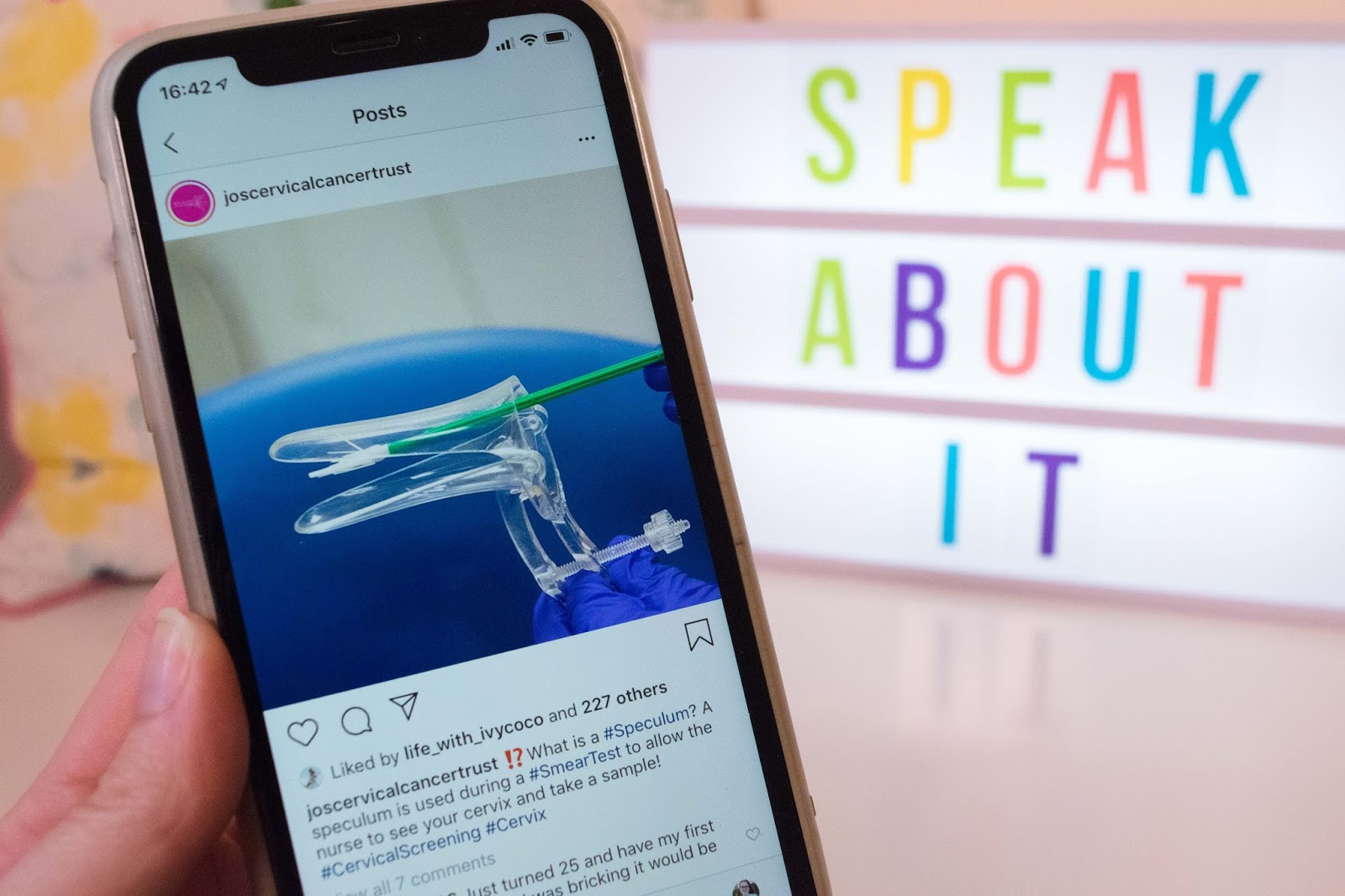
According to the charity Jo’s Cervical Cancer Trust, attendance for cervical screening (or smear tests) is at a 19-year low in England and a 10-year low in Scotland and Wales. This means that, when they receive their invitation letter, one in four women are not making an appointment to be checked. Things are going on to try and help reverse this shift. For example, the recent Channel 4 documentary about Jade Goody’s life, which includes her journey with cervical cancer, has got a lot of women talking about, and booking, their cervical screening tests. And recently, Zoe Sugg (aka. Zoella) uploaded a video that showed her having a smear test and asking the nurse various questions about the procedure. Over 1.4 million people have watched it so far. And it’s not just these high profile celebrities who are raising awareness of why it’s so vital to go for your cervical screening appointments. You only have to look at Instagram to see hundreds of thousands of pictures discussing the importance of having regular smears. 


And don’t get me wrong – this movement of women taking ownership of their health and encouraging others to do so too is fantastic. And for most people, these campaigns are enough to inspire them to book an appointment and get checked themselves. But the thing I struggled most with, was trying to find stories from people for whom having a smear test isn’t as straightforward as most people say it is. In amongst all the amazing posts and media about why it’s so important to have a smear test, I also found a lot of content shaming people for not having one. And that’s why I have decided to write this post. Not to put people off going for their appointments or to scare people off who haven’t been for a test yet. But to reassure others that they’re not alone if they struggle, for whatever reason, to go for their cervical screening. And that that struggle is nothing to be ashamed of. 


Like most women, I received an invitation to go for my first smear test just before my 25thbirthday. As someone that has had a huge number of medical tests over the years, I wasn’t too worried about the prospect of another one and so, fairly quickly, booked in with my GP Practice. On the day of my test, although feeling a little apprehensive about something new and different, I went in to see the nurse on my own, as I have done with many tests before. She asked me all the usual questions and told me how the test would be carried out, and then asked me to lay on the bed so she could proceed with the test. And this is where things started to go wrong. I found the test incredibly painful – so much so that I was in tears because of it. It didn’t help that the nurse I saw didn’t seem to be particularly gentle or sympathetic, and made comments about how difficult I was making it. After what felt like ages she finally managed to get the sample and I left feeling completely traumatised. 


Thankfully the result came back negative, so I tried to just forget about my experience for the next three years. But when my next invitation letter came three years later, the panic set in. I just couldn’t face going through that experience again. In the end, I went to talk to my GP about it. She told me that it was my choice whether I went to have the cervical screening done and that I didn’t have to get it done if I didn’t want to. But the problem was, I did want to – I knew how important the test was and I wanted to make sure I was doing everything I could to keep myself as healthy as possible. We talked about it quite a lot and in the end, decided that I would give it a try and if things really didn’t work, then we could talk again. She did also recommend asking the nurse to use a smaller speculum. 


And so, with a lot of apprehension, I booked in for my second cervical screening test. This time round, I decided to take my Mum into the test with me for some moral support. Pretty much as soon as I entered the room though, the nurse asked me why I’d brought my Mum in. I explained that I had found the test traumatic last time and for a couple of other reasons as well, I just needed someone I trusted with me. The nurse then told me that it was very strange that I would bring someone in with me and that she’d never seen anyone else need to do that before. My Mum was told to wait in the room next door while I had the test, so I was effectively on my own. So before we’d even started the test, I was feeling humiliated and upset for being what I now felt was strange. And the test didn’t go much better. We had the same problems with excruciating pain and the nurse not being particularly gentle while she tried to find my cervix. She kept telling me that my cervix was in a funny place and that I shouldn’t be in so much pain. Despite all this, somehow, she managed to take a sample and I left. 

I remember leaving the Doctors Surgery and bursting into tears – I felt like there must be something really wrong with me. Everyone else I had spoken to or heard talk about having a smear test said it was, at worst, a bit uncomfortable, but was over in a couple of minutes. So why wasn’t it like that for me? Ever since then, I have felt embarrassed about the whole process and the fact I couldn’t do what every other women could apparently do. 


Then a few months ago, I received my next invitation letter and my anxiety hit the roof again. This time, I really was tempted to just not go because after two horrible experiences and some other life events that have happened, it felt like burying my head in the sand was the easiest thing to do. Problem was, I had been getting some bleeding in between my periods and knew that, if I went to see my GP about it, the first thing she would say is that I needed a smear test. Plus, the bleeding was also giving me massive anxiety because I had no idea what was causing it. So I could either ignore my letter and continue to worry about the bleeding, or book an appointment and worry about the test instead. I went for the second option.

Out of all the medical tests I’ve had (and some have been pretty horrible) I think this was the one I felt most anxious about. In the weeks leading up to my appointment I was getting panic attacks, not sleeping properly, nightmares and generally just felt awful. The day came and this time my appointment was with a new nurse I had never seen before. I decided to go in on my own and I’m pretty sure as soon as I sat down the nurse could tell how anxious I was! She talked to me for quite a while, going through the normal questions and asking about previous tests. I tried to explain to her about the problems I had had with my previous tests and how worried I was about being there. I also spoke about my Ehlers-Danlos Syndrome, and how it can make it more painful to lie in the correct position. She was very sympathetic, listened to me and I didn’t feel judged at all, which started to put me at ease. As I lay on the bed, she explained exactly what she would be doing and showed me the instruments she would be using. She had got out a smaller speculum at my request and showed me exactly how it worked. Then she told me she would talk me through everything she was going to do and that if, at any time, I was finding it too difficult, I could ask her to stop.


The first time she tried I think I nearly shot through the roof because of the pain it caused, but true to her word, she immediately stopped and gave me some time to just breathe, move around and relax. When I was ready, she tried again, and this time, although it was uncomfortable, I wouldn’t say it was painful. I tried to focus on my breathing to keep myself calm, but after a while, the nurse told me that she was unable to find my cervix and would need to try again. My heart sank. But the nurse was lovely about it. She told me to make my hands into fists and then place them under my bottom, as this would help to tilt my cervix into a better position. She then tried again, and in a couple of minutes the test was complete. I think I nearly cried with relief this time rather than from pain or embarrassment. 


After I’d got dressed, I sat down with the nurse again, and she told me that I have a tilted cervix, which is what makes it harder to find. She reassured me that a lot of women have it, so it’s nothing strange or abnormal about me. She also told me that I have something called a cervical ectropion, which is very common among women who are on the pill, and could well be causing some of the pain and bleeding. I honestly just wanted to cry – finally someone was explaining to me why I might find having a smear test more difficult than some. This time, I left my appointment feeling relieved and empowered, all because I had a supportive nurse that really listened to my needs and worries.


Now don’t get me wrong, I’m still pretty anxious about having to have my next cervical screening in three years time because I know that it is still likely to cause me pain. And being disabled just adds to the issues by making it more difficult to access. But I guess I wanted to tell my story because it shows just how important it is to find a medical professional that you can really talk to about your worries when it comes to your smear test. There are so many different things that can be put in place to make the experience more manageable for you – that could be using a different sized speculum, having a friend/relative come with you (which, by the way, is completely normal and lots of people do it!), making adjustments for a disability or even going to a specialist hospital clinic for people who find smear tests particularly difficult.


So whether it’s your first smear and you’re scared of the instruments they use, whether you need to wear fancy underwear or if they will judge you for how you look down there. Or if it’s your third, fourth, fifth plus test and you’ve had experiences in the past that might make the whole process more difficult for you. My biggest piece of advice is to just talk to someone. Whether that’s your Mum, sister, friend, GP, the nurse or even a charity like Jo’s Trust (0808 802 8000). If something is worrying you about your smear test – anything at all – please talk to someone. I promise you’re not alone in finding it difficult. And the more we speak about our own experiences, the more people will realise that every smear test is different and that it’s OK if yours isn’t a straightforward process. 


Have you found having a smear test difficult? What advice would you give to others in a similar position? 

Thursday, 15 August 2019

My Experience of Train Travel with a Disability

I can’t remember the last time I made a journey by train and didn’t have some sort of accessibility problem. It’s happened so much now that I just can’t ever imagine being able to take a train somewhere on my own. With every journey I make, I live in constant anxiety about what’s going to go wrong next. And it really shouldn’t be like this for anyone. Train travel should be accessible to all. 


One of my biggest bugbears about taking a train in the UK as a disabled person is that there is very little opportunity to be spontaneous. As an able person you can pretty much turn up to any station without prior warning, buy a ticket and hop on a train to anywhere you fancy. But if you’re going to need assistance getting on and off the train, you’re expected to have made arrangements at least 48 hours beforehand. OK, so most train companies say that they ‘recommend’ you book assistance before you travel, but in reality, you often get a lot of stick if you don’t follow that recommendation. 

I travel up to London quite a lot for medical appointments, which means needing to use both mainline and London Underground/Overground services. Medical appointments in themselves will often create higher levels of anxiety, so add into that needing to travel long distances and you’re already starting the day feeling more vulnerable than usual. For the majority of my outward journeys, I tend to ring up ahead of the day and let the train company know that I will need a ramp to get on and off the train. That’s usually the easy part. I give them my details, tell them I’m in a wheelchair and let them know which trains I am planning to use to get to my destination. 


So far so good, right? Well, apart from the fact that this then ties me down to having to catch an exact train, as well as having to make sure I am quick enough to make any connections, it wouldn’t be so bad if it actually worked! But, ninety nine per cent of the time, I will arrive at my local station, wait patiently on the platform for my train to arrive and then when it does, no one will have any knowledge of me needing assistance. Sometimes the guard will spot me on the platform, ask if I’ve booked assistance and when I say that I have, will say that they hadn’t been told. But at least then, they will usually find a ramp and get me on the train. But a lot of the time, the person I’m travelling with (or fellow passengers) end up running up and down the platform trying to find the guard before the doors close and the train leaves the station. So I end up wondering – is there actually any point in booking assistance in the first place?!

My experience when I’ve supposedly booked assistance isn’t particularly dissimilar to my journey home again when I haven’t. It’s impossible to book assistance in advance for my train home from hospital (or any other trip to be honest!) If it’s a hospital appointment, I have no idea whether I’ll be seen on time, how long I will end up waiting, how long my appointment will last and whether I will need to do anything else after that appointment. And if it’s not a trip for a medical appointment (like, on the odd occasion, I do actually like to try and do something fun!) then I don’t really want to feel like I’m constantly working to a time limit – it just adds constant pressure to my day and takes away any enjoyment. So I don’t ring 48 hours in advance to book assistance for a particular train. 


And like my journey out, I reach the station and am usually asked by station staff whether I’ve booked assistance. So many times, when I answer ‘no’ to this question, I am made to feel like I’ve done something wrong and that I’m an inconvenience. Even when I give my reasons for not booking (which I really shouldn’t have to do) I’m still told that I really should have booked if I wanted help. I’ve effectively been ‘told off’ by station staff before for not doing things ‘properly’ – way to make a disabled person feel completely humiliated! I just can’t comprehend why train companies can’t understand that disabled people just want to be able to travel in the same way as everybody else! How would they cope if someone told them that they had to plan the exact trains they needed to get every single time they needed to go out somewhere? 

One of my worst train experiences happened fairly recently after a hospital appointment in London. I came back to the first station of my journey to find absolutely no station staff anywhere. The ticket barriers were up, the ticket office was closed and there was nobody on the platform. Sitting in my chair on the platform, I hoped that the train would have a guard who could at least help me. But when it turned up, there was no guard on this particular train (and this is one of the reasons why I completely support the need for guards on trains!) Other passengers got on and off, and all I could do was sit by the door, hoping that someone might notice that I was stuck, while my Dad ran up and down the platform trying to find someone. 


Another passenger noticed that I couldn’t get on and asked if there was anything she could do. I use an electric wheelchair that weighs around 100kg, so short of learning how to levitate there’s unfortunately not a lot anyone can help with. She was absolutely lovely though and ended up running down to the driver to tell him that I needed to get on. This situation began to draw the attention of other passengers, who were either staring at me, or watching this lady attempt to talk to the driver. There was quite a commotion happening as we watched the driver throwing his hands in the air at this lady. As she walked back down the platform towards me, she told us that the driver had simply shouted at her for causing a problem and told her to go away. So, she then decided to simply stand in the doorway so the doors couldn’t close and therefore the train couldn’t leave. The driver eventually had to come down himself and get the ramp for me, much to his protests and anger. I understand it wasn’t really his job, but again, it’s not nice to be on the receiving end of someone’s anger for something I can’t do anything about!

Whilst I massively appreciate the passenger standing up for me (I would probably still be stuck on the platform if it wasn’t for her!) it is hugely embarrassing to have everyone’s eyes on you because you simply can’t access public transport. It didn’t help that the train driver then made an announcement to the whole train that the reason for the delay was that there were no platform staff to help me! I just wanted the ground to open up and swallow me. So whilst of course I appreciate other passengers looking out for me and standing up for my rights, I would much rather that they didn’t have to at all. I don’t want to make a big scene when I use public transport. I just want to get on and off like everyone else does! On this occasion, I was so close to crying because I felt completely humiliated and embarrassed about the whole situation. This isn’t accessibility or equality!


There are so many other things that have gone wrong when I’ve travelled by train in my wheelchair. Whether it’s lifts not working (and being shipped off on different trains all over the place), people using the wheelchair spaces for luggage and refusing to move, not being able to get off a train and ending up stuck going to completely the wrong place or not being able to access the toilets on a train journey and therefore having an accident. 

Yes, there are staff that try their best to make train travel accessible to those with disabilities and I will be forever grateful to the ones that do. But I think this problem goes higher than individual station/train staff. Why, in 2019, are our railways still so inaccessible to people with disabilities? I know so many people who simply don’t or can’t travel because the accessibility just isn’t good enough. People, who could, if disabled access was given more thought, actually go out on their own, be independent or leave their town for the first time in years. But instead, they end up trapped in a small bubble – unable to access medical appointments, unable to go to work and unable to go out and have fun. Simply because disabled access doesn’t seem to be a priority. 


I want to be spontaneous. I want to be able to get on a train without drawing unnecessary attention. I don’t want to arrive at a station and feel absolutely terrified that I’m going to be told off, left on a platform or end up trapped on a train because there’s no way off. I want to be able to access the world, to enjoy myself, to get to my medical appointments on time. And I don’t think that that’s too much to ask.


If you’re disabled, what are your experiences of travelling by train? And if you’re not disabled, what are your thoughts on disabled access on trains?