Showing posts with label Hospital. Show all posts

Friday, 5 February 2021

Reflecting on 2020 and my Goals for 2021

It’s hard to know how to start this post after not updating my blog in so long, so I think I’ll just start by saying ‘hello’ again! Being quiet on here since July hasn’t been deliberate. I’ve desperately wanted to share posts and have a growing list of ideas of things I’d like to write about. I’ve just struggled to actually do it! A mixture of my health being decidedly rubbish since my major surgery in November 2019 and a global pandemic affecting both my physical and mental health haven’t made for a very productive Jenny. But one of my goals for 2021 (more on those later) is to really try and start getting some content out on here again, even if it’s just writing little bits here and there. So here I am with my first post of the year! And I thought a good place to start would be to just reflect a bit on the past year and then look forward to the year ahead.


Reflecting on 2020


Where do I even start with reflecting on the last year?! It’s certainly been a strange and scary one for most of us hasn’t it? I started 2020 having just had major leg surgery (a Femoral Osteotomy). I was spending the majority of my time sleeping, keeping dosed up on various painkillers and having regular physiotherapy. I saw 2020 as my year to recover – to gain strength, increase my mobility and to start doing some of the things I enjoy again as I started to get better. But I hadn’t planned for two things – one, that complications from surgery would make recovery increasingly difficult and two, that we would be plunged into a global pandemic. 


I always knew that the surgery came with risks (with added risks on top because of my Ehlers-Danlos Syndrome). But I think when you go in for any kind of surgery, you convince yourself that you will dodge these risks and that things will go smoothly – otherwise you wouldn’t go ahead with the surgery! And a lot of the time, things do go to plan. You have your surgery, it resolves the problem, you make a good recovery and generally your life is better for having that intervention. But occasionally, things aren’t quite so straightforward. And this seems to have been the case for me this time. 


The place where they broke my femur has actually been healing quite nicely (albeit rather slowly). But unfortunately, the surgery has affected my knee and nobody seems to know why. As the months have gone on, I’ve been struggling to bend my knee, have been getting a lot of pain and swelling in it and have been finding it hard to put much weight through my leg because of this. It’s been incredibly frustrating, especially as my mobility is now worse than it was before I had the surgery (which definitely wasn’t the plan – it was meant to try and improve it!) 


And unfortunately a global pandemic hasn’t helped matters, as it meant my physiotherapy had to stop and I struggled to get appointments with my surgeon. When I did eventually manage to see my surgeon in person, he let me know that because my appointment (and possible treatment) had been delayed due to Covid, there is a very real possibility that I may never regain the full use of my leg again. Devastated is definitely an understatement! I don’t blame my surgeon – he’s just as frustrated by the situation as I am and it’s not his fault we’re in a global pandemic. But I am obviously angry and upset at Covid for potentially losing me the full use of my right leg. 


I’m trying to stay as positive as I can in the hope my surgeon can find an answer and that I will see some improvement. But it’s not easy, especially when it’s still so difficult to access services because of the strain of the pandemic.


And that brings me on to the second significant thing that happened in 2020 – Coronavirus. It’s obviously been a difficult time for everyone, although we have all been affected in slightly different ways and perhaps some more negatively than others. I can only really talk about the effect it’s had on me and my loved ones, but I don’t want to dismiss the fact it’s impacted each and every one of us and that some people are struggling a lot more than others. 


For me, in some ways, I guess I’ve been kind of lucky in a strange, roundabout kind of way. Having been chronically ill for the last 17 years, often spending large parts of my time housebound, being put into Lockdown wasn’t a huge shock for me. Chronic illness had prepared me pretty well for not being able to leave the house. So while a lot of the world struggled to come to terms with staying at home for months on end, the chronic illness community didn’t see our day-to-day lives change particularly. 


Don’t get me wrong – it was really hard to suddenly hear everyone complaining about being ‘stuck’ at home, telling everyone that they didn’t know how they were expected to live like this for so long. It was strange to suddenly be surrounded by people living a life that you have lived for so many years without any recognition. All of a sudden things started to be made available to people who couldn’t leave the house. It was possible to work from home, medical appointments could be done via video call, virtual tours were made available for museums and gardens and communities came together to ensure those who were housebound had access to food, medication and company. 


For a lot of the chronic illness and Disabled community, these changes were a double-edged sword. In some ways it felt really great to see the wider world being made accessible for the first time. I have friends who were finally able to speak to a doctor after struggling alone for years because they weren’t well enough to get to a physical appointment. But it was also incredibly frustrating and hurtful to see these adaptations be put in place with such ease and speed. We have been asking for them for years and have either been ignored, or been told it simply isn’t possible. Imagine developing a chronic illness, asking your work if they will facilitate working from home to enable you to still do your job and then having to leave when they tell you that the job can’t be done from home. And then, to add insult to injury, someone else is given your job and is then given the adaptations needed to do the job from home. It was possible all along, but only when a situation arose that affected non-disabled people. 


I think the way Disabled people have been treated over the last year is one of the things that has affected me most during the pandemic (other than losing the majority of my medical care and the fear of myself and my loved ones getting the virus). I’ve been well aware of ableism growing up, having been Disabled since I was 15. But over the last year it has become so overwhelming that it’s been difficult to escape, even in the safety of my own home. 


Constant comments on social media like “Only the elderly and vulnerable will die,” “the vulnerable should just stay inside so the rest of us can get on with our lives,” “the vulnerable should take responsibility and protect themselves – it’s not our job to mollycoddle them” and “why should the majority suffer to protect the few” have been hard to ignore. 


Finally being able to leave the house and finding Disabled parking bays have been turned into queuing areas or toilets have been closed has made it even harder for Disabled people to access the world. And knowing that, in the first half of 2020, 59% of all deaths involving Covid-19 were among disabled people was terrifying to hear. 


This year, it’s just felt like things have gone backwards with our society’s attitudes towards Disabled people, and it’s been really sad (and quite scary) to witness. I know a lot of Disabled people have found this has taken a toll on their mental health (myself included). So I hope anyone who is reading this that has been affected in a similar way is doing as OK as possible at the moment. It hasn’t been easy (and it’s hard to see things improving any time soon) but you’re doing an amazing job simply getting from one day to the next, so please don’t be too hard on yourself. Apart from my family and friends, the one thing that has kept me sane over the last year is the amazing Disabled community I have found on social media. Perhaps I’ll do a blog post at some point sharing some of my favourite accounts, as feeling a part of a community who are fighting back, showing that being Disabled isn’t a negative thing and supporting each other through this has been a real lifesaver. 


Goals for 2021


So moving onto this year – I often find it quite difficult to set New Year’s Resolutions and goals to be honest. Being chronically ill, life can be pretty unpredictable and so it can get quite demoralising setting goals and then finding my health just won’t allow me to achieve them. Add into the mix a global pandemic, and it almost feels impossible to look ahead and find things to aim for that I know will be achievable. However, I do think setting myself targets is important, as it helps me to have positive things to focus on and gives me some motivation on those days where it’s seriously lacking! So this year, I’ve tried to set myself goals that I should be able to achieve regardless of what’s happening with the pandemic (and my health to a lesser extent). I’ve tried to focus more on self-care – doing things that I know will help me to feel a bit better physically and mentally – because I think that’s what I need right now. I thought I’d share them with you, partly to give myself some accountability, but also just in case it helps anyone else who’s trying to set goals but doesn’t know where to start. So, my goals/resolutions for 2021 are:


Go to bed earlier


I’ve always been a night owl, but since the pandemic hit, I’ve got into a really bad routine of going to bed far too late. In some ways it does work for me (I guess that’s why we get into bad habits, because they do serve a purpose, even if it’s not in the best way) but I also know that it’s not the best routine to be in because it leads to me getting up a lot later in the morning and generally just feeling pretty groggy. So I really want to get myself into a better routine of going to bed a bit earlier. I’m not saying I’ll be in bed by 10pm, as that just isn’t how my body works, but I do want to gradually bring my bedtime forward until I get to a place that feels right for me. And I’m hoping it will bring the added bonus of giving me a bit of time to start reading again before I fall asleep because at the moment, I’m just too tired to even try.


Get back to doing my skincare routine


I used to religiously follow a skincare routine of cleansing, toning and moisturising every day. But when I had my leg surgery, it kind of went out the window a bit and for some reason, I’ve really struggled to get back into doing it. I think part of the reason is because I’ve felt so rubbish since having my operation – I just haven’t really felt like doing anything nice for myself, partly through feeling physically unwell and partly through my mental health not being great. And this is something I want to work on because I know spending a few minutes each day giving myself some simple pampering can make a big impact on how I feel. Even if I start with something very simple – like putting a bit of moisturiser on – I want to get back into consistently making time to look after my skin.


Post on my blog more


So as I mentioned at the beginning of this post, things were pretty quiet on my blog during 2020. And it’s something I really want to change. My blog is where I first started creating content before I expanded to Instagram and YouTube, so it holds a special place in my heart. I love writing and taking photos – it just ended up falling by the wayside a bit recently as my energy was being used for other things. I don’t want to compromise on creating content for my other platforms, so I need to try and manage my time a bit better so I can start getting some more posts on here. Apart from my energy levels, I think one thing that continually stops me posting on here is not feeling like my work is good enough. Comparing my photos to other bloggers who take the most beautiful pictures, doubting myself over whether I have something interesting or useful to say and worrying that, because I can’t get out much, what I post won’t be interesting enough – I’m constantly telling myself that there’s no point in trying because it won’t match up to what other people are doing. But the more I think about it, the more I realise how ridiculous that all sounds. I follow a whole variety of content creators and the things that they post are so diverse, and that’s why I like them. And even if no one wants to read my ramblings, I enjoy writing them and taking the photos, so I think that’s the most important thing to focus on. 


Be open-minded about treatment for my leg


As I’ve talked about in this post, my post-surgery recovery from my Femoral Osteotomy has not been going to plan. To begin with, I was quite fixed with my ideas of what was causing the problems (I thought it was all down to the rotation issues with my lower leg, and believed that by having that corrected, everything would be fixed). But, with the help of my surgeon and other medical professionals, I’m starting to realise that it probably isn’t as ‘simple’ as that, and it may be a case of a number of problems going on that we have to deal with (i.e. muscle and nerve problems too). Because of this, I feel like I need to try and be a bit more open-minded about possible treatments I’m being offered. It’s not discounting that I’m likely to need further surgery at some point to correct the misalignment in my lower leg (and possibly sorting out my other leg at some point!), but just recognising that it’s probably not a straightforward issue and that I may have to have other treatments to get me to a place where surgery can be considered. 


Less mindless scrolling


It’s only fairly recently that I’ve realised just how much time I spend scrolling through social media on my phone and how much of a negative effect this has on my mental health. I definitely think it’s got worse since Covid came along – perhaps because there’s a bit more time, but also because I think I’ve got a bit drawn into reading comments on news articles on Facebook, which really isn’t good for my mood and anxiety levels! I have a bit of a love/hate relationship with social media – in some ways, I find it completely draining, while in other ways, I find it a great place to keep in touch with friends and to feel part of an amazing community of disabled and chronically ill people. So I guess I just want to make sure I’m using it more mindfully, in ways that make me feel good. I’ve already decided not to look at Facebook before I go to bed because I know it just triggers my anxiety and doesn’t help my brain to wind down. And instead of just scrolling and scrolling, I want to use the time I’m on social media to create more content, reply to more messages/comments and interact with users who make me feel happy and empowered. 


Be kind to myself


This last resolution is probably my most important one, but is also the one I know I’m going to find the hardest. I’ve never been very good at being kind to myself. It’s a major underlying theme of my mental health problems and I can trace it right back to my childhood. But I know it needs to change if I want to keep as well as possible. I know it’s a bit non-specific, but that’s kind of deliberate, as if I make it really specific, it will just be another thing I can use to berate myself when I don’t achieve it. I’d rather see it as an overarching theme, rather than a set goal. It could include things like not giving myself a hard time if I have a day where I don’t achieve one of my goals, letting myself start the next day afresh, cutting myself some slack when I’ve felt too exhausted/unwell to do anything but get out of bed and eat. There’s a never-ending list of little things I can do to just be a bit kinder to myself, so I just want to try and be more conscious of my thoughts and actions towards myself and to continually question whether I would treat a friend the way I’m treating myself. I’ve got a long way to go to get to a place where I accept and even love myself, but starting small and making the first step is the only way to start.


How did you cope with 2020? Do you have any goals for the year ahead? And do you have any advice that might help me with mine? 


Thursday, 30 January 2020

Femoral Osteotomy - The Operation and Early Recovery

It’s been a while hasn’t it?! I should start by wishing you all a Happy New Year – I hope 2020 will be a good one for you. Sorry it’s been quite a long time since I last updated. As you might have seen in my previous post, back in November I went into hospital for major surgery to my right leg – a Derotational Femoral Osteotomy. And to say things have been difficult would be an understatement! So I thought I would write a post updating you on the actual operation and how things have been since then. 


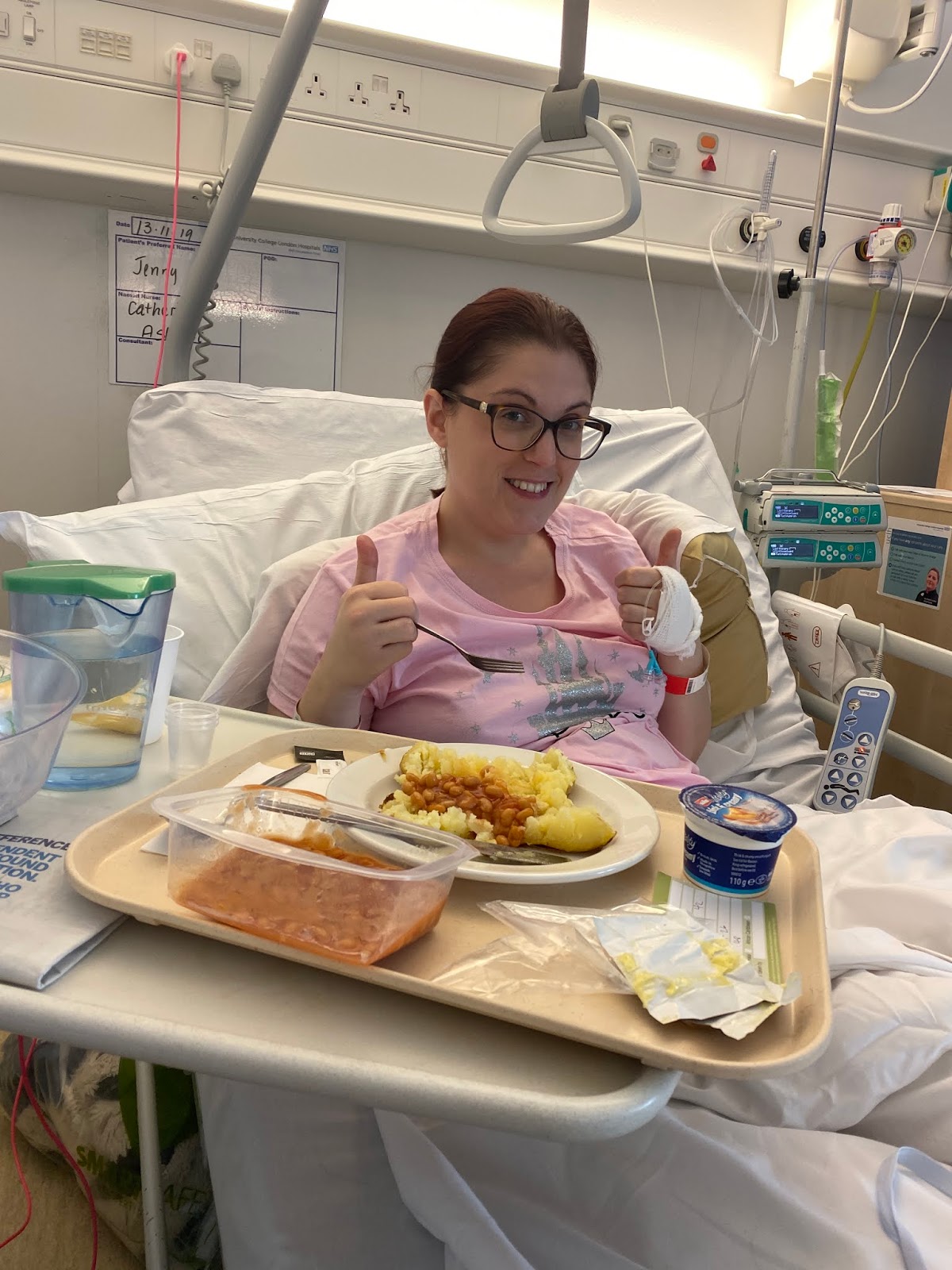
I had to be up really early on Tuesday 12th November 2019, as my Dad and I needed to get the first train up to London to be at UCLH for 7am. Thankfully at that time in the morning we didn’t have to worry about the traffic, so made it there in plenty of time. In fact, we were too early in the end and had to wait outside the Surgical Reception waiting for it to open! Once I’d been checked in, I was seen by a Doctor, who went through the operation with me and marked my right leg with a big arrow (just to make sure they did the correct one!) I then saw the Anaesthetist to discuss the anaesthetic and pain relief. They would normally give someone having this operation a general anaesthetic and epidural, but because I’m allergic to morphine (and they use this in an epidural), he said they would do a nerve block (and GA) instead. Working out my pain relief options was also a bit tricky because I’m allergic to so many painkillers! But we decided I would have a Fentanyl PCA (Patient Controlled Analgesic – a button I could press so I could deliver my own pain relief) post surgery. After changing into a gown and saying goodbye to my Dad, I was taken down to a small waiting room near the operating theatres. You’re only meant to be kept there for a short while, but someone had got the timings muddled up, so I ended up down there for a few hours – thankfully there was a stream of other patients coming and going for me to talk to! 

At about 1pm, I was taken down to be prepared for theatre. I was feeling pretty shivery, so they put this thing called a ‘Bear Hugger’ over me – it’s like an inflatable blanket that connects to what looks like a hairdryer, which blows warm air inside the blanket at a temperature they can control. It was so cosy – I think I need one at home! The anaesthetist gave me some sedation, although he had to give me a few doses before it had any effect. He was then able to do the nerve block, which meant lots of injections around the top of my right leg. Then came the general anaesthetic and next thing I knew, I was waking up in recovery around five hours later.


Initially, I didn’t feel too bad as I came round. The nerve block was still working, so I could feel very little pain. I was mainly just groggy and tired from the anaesthetic. Once my numbers were looking stable, I was taken up to the Orthopaedic ward. As night progressed to morning, my pain was getting more and more difficult to tolerate, despite the Fentanyl PCA. When the Doctors came round to see me in the morning, I was in tears from the pain, so they said they would get the pain specialists to come and talk to me. Unfortunately though, after seeing the Doctors, things went downhill pretty quickly.


I don’t have many clear memories from Wednesday or Thursday, so most of what I know is from what I’ve been told by medical staff and my family. After seeing the Doctors, I remember just not feeling right. I was shivering and shaking but didn’t really know why, as I definitely wasn’t cold. I was also feeling very ‘out of it’ and couldn’t really communicate with the Doctors and nurses. I think at first, they were concerned that I might be developing sepsis, and so started to follow the protocol for treating that. But then I started having seizures and was drifting in and out of consciousness throughout Wednesday and into Thursday. They did various blood tests and found that a lot of my electrolyte levels (things like potassium, calcium etc.) had plummeted very quickly, which can result in seizures. So I was attached to various drips to try and get them back into a normal range. However, this didn’t seem to make much difference and, on Wednesday night/Thursday morning, my parents were called to tell them the staff had had to do an emergency crash call because of how unwell I was. 


I have vague memories of lots of voices and seeing different faces, but everything feels very disjointed. I could sometimes hear people trying to ask me questions, but I just couldn’t seem to speak or communicate in any way. I remember having an awful headache, pain in my chest, not being able to breathe properly and feeling really scared and confused about what was happening. After the crash call, the Intensive Care Outreach Team were called to come and look after me on the ward because I was too ill for the ward staff to manage. Thankfully with their expertise, they were able to keep me out of the Intensive Care Unit and gradually, the seizures stopped and I started improving. I was sent for a CT scan to check that nothing serious had caused the seizures and that the seizures hadn’t done any damage to my brain, but thankfully that all came back clear.

Once I was a bit more stable, a Neurologist came to see my Dad and me. He had read the detailed notes that staff had kept and, based on their observations and my test results, he told me he thought I had experienced Non-Epileptic Seizures due to a Functional Neurological Disorder. Basically, when your body is under stress, either mental or physical, your brain sort of shuts down as a way of coping. He said that because I was in so much pain from my surgery and was also really unwell from my electrolytes being all over the place, that my body simply couldn’t cope and shut down, which then caused the seizures. It’s something I’ve got to look into further with a referral to a Neuropsychiatrist and I’ve also had to inform the DVLA, who are likely to revoke my license again, which I’m gutted about (but obviously understand). 

I was absolutely covered in bruises on my arms from all the needles I’d had stuck in me while I was so ill, and felt very drained, mentally and physically, as seizures really take it out of you. I was sent for an x-ray to make sure the bones in my leg were all in the right place, especially after having all those seizures, and luckily everything had held well.


Once the Intensive Care team had stabilised me, my Dad started to help me get some nutrition inside me, first by drinking some Ensure drinks and then by spoon-feeding me with things like yogurt and potato. I gradually started to feel a bit better (as much as you can after major surgery) and was able to start sitting up a bit and eating/drinking a bit more. When the Doctors were happy that I was more medically stable, the physiotherapists came round to see me. The first time they saw me, they started by getting me to move my feet. Then they helped me to slowly sit up, put my legs over the side of the bed and stand up while holding onto a walking frame. Just that ‘simple’ task of standing up for a few seconds completely wiped me out and I slept for quite a while afterwards.


I was a bit shocked to start with at how swollen my leg was. I remember when I looked at my leg for the first time; my right thigh was pretty much double the size of my left thigh! There was also quite a lot of bruising, which gradually spread and got worse as the days went on. What with all the bruises on my arms and my right leg looking like it did, I definitely looked like I’d been in some sort of fight (and probably lost!)


One of the best things about the ward I was on at UCLH (apart from the amazing staff and lovely patients that I got talking to!) was the incredible view from our windows. Whenever I’ve been in hospital before, I’ve either not had access to a window at all, or the view has been of something like a car park or another hospital building. But with being so high up (I was on floor ten) and being in the middle of London, we had amazing views of the London skyline. I moved bays halfway through my stay, so from my first bed I could see the London Eye, and from my second bed I had a fantastic view of the BT Tower, which looked really pretty lit up at night. We all joked that people would pay top money to have a view like that of London and we were getting it for free (let’s ignore the fact I was having to recover from very painful major surgery!)


Over the next few days, the physiotherapists kept coming back to see me and we gradually progressed from standing with the frame to walking a few steps, until I could get to the toilet and back. It took me a while to get my head around putting any weight on my bad leg, firstly because it was ridiculously painful (even with lots of pain relief) and secondly, because I was so aware of my leg being completely broken and held together with metalwork that I was scared it would just all come apart underneath me at the slightest bit of movement or weight bearing. The doctors and physiotherapists explained to me though, that weight bearing as pain allows actually helps with recovery of the bones and muscles. Easier said than done when you’re in agony, but I was managing to put a small amount of weight on my toes. After several days of practising walking with the frame, the physiotherapist then started moving me over to using ‘gutter’ crutches (crutches that you lay your whole forearm in – I have injured my wrist and so standard crutches would have made the injury worse). I found the crutches pretty difficult at first because I was so wobbly, but with practise, I was just about managing to get to and from the bathroom.


I spent a week in hospital at UCLH altogether – a bit longer than expected, but with being so unwell after the surgery it took us longer to get me stable and up on my feet. I was discharged at about 6pm on Tuesday 19th November and had to make the journey home from London, which was hard work to say the least! We got a taxi from the hospital, although trying to get into the cab wasn’t easy. They put the ramp down, but it was so steep that we found it a real struggle to get my wheelchair in. We then had to get a train from Waterloo, although with it being quite late it meant the train was fairly quiet thankfully. It felt so good to get home and lay down on the sofa!


Since being home from hospital, things have been difficult. I spent the first few weeks crying a lot of the time. The pain was intense and I find anaesthetics really affect my mental health. I think it was also dawning on me quite how big this operation was and just how difficult the recovery was going to be. I had to give myself blood thinning injections in my stomach once a day to reduce the likelihood of blood clots, which took a while to get my head around, as I’ve never had to inject myself before! It also took a few weeks to chase up physiotherapy, as some paperwork went missing, so I felt a bit lost as well. I had reduced my painkillers massively (thinking it was the right thing), but after ringing the specialist Orthopaedic nurse and being told it was normal to still need a lot of pain relief, I started taking them again, which helped a bit. 


But most of my time has been spent laid out on the sofa sleeping and trying to concentrate on things on the TV. However, within the first week of being home, we noticed I was beginning to develop pressure sores on the backs of my heels. I have pretty fragile skin because of my Ehlers-Danlos Syndrome and have had the start of a pressure sore before, so knew I needed to get on top of them before they got any worse. Luckily my GP surgery were brilliant – as soon as I contacted them, I was seen by a nurse who gave me some dressings to wear while I waited for something more permanent. A Community Nurse then came out to visit me and immediately ordered a selection of pressure cushions for me to sit/lay on. I’ve been using them ever since and my heels have healed up nicely, although I am now starting to have problems with the tips of my toes so might need to get some more advice.


Starting physiotherapy in the community has been hard, although I’m lucky to have a brilliant physio who pushes me a bit, but not too much. To begin with, we were struggling to get my muscles to do much at all, so it’s been a very slow process of doing little exercises at home, along with manual manipulation from the physio regularly. I still can’t move my leg very much but my physio thinks the muscles are getting stronger and it’s a bit easier for her to do some movements with my leg. She’s been a bit concerned that things aren’t moving much, so I now have two appointments a week and I’ve been referred for hydrotherapy. I saw my surgeon recently for an eight-week check-up. He said the bone seems to have started growing but it can take at least nine months for it to fuse back together completely. I’m having a lot of trouble bending my knee and my foot now sticks out to the side, which is causing pain. At some point I may need an operation to my lower leg to straighten things out, but the surgeon said they wouldn’t touch my leg for at least nine months. So for now, it’s just a case of working slowly on my physiotherapy to try and strengthen my muscles and improve the movement. 


I had planned to do more regular updates about this operation, every few weeks to detail how the recovery was going. But I think I underestimated just how much the whole thing would knock me for six! So apologies that this is one big update instead, but I hope you’ve found it interesting (or even helpful, if you’re going through something similar) to hear about. Do let me know if you would be interested in future updates as my recovery progresses, and also when I possibly have the lower leg and other leg operated on as well. And you can always watch my Weekly Vlogs on my YouTube channel to keep up with more regular news about my recovery and life in general.


Have you had a Femoral Osteotomy? Or do you have any questions you would like to ask about my experiences of it? 

Monday, 11 November 2019

Life Update - An Operation - Derotational Femoral Osteotomy

I want to start today’s blog post with two apologies. Firstly, to apologise for the lack of content in recent months – it’s safe to say I’ve been slacking a bit (OK, so actually my health has been rubbish and so I haven’t been able to write so much). But that’s in the past and there’s not much I can do to change that. And secondly, I need to apologise for the fact there probably won’t be much content going up for the next few weeks at least. Not the greatest place to start a blog post! But I wanted to use this post to give you a bit of a life update and let you know why I won’t be around much over the next few weeks, so at least you know I haven’t completely forgotten my blog!


In short, I’m going into hospital to have quite a big operation – a derotational femoral osteotomy (I’ll explain more in a minute!) It was meant to be happening on Thursday 7th November, but I had a phone call last week to say it had been postponed. So it is now (hopefully!) happening on Tuesday 12th November instead. As well as wanting to update you in this post, I also thought it would be useful for others, and myself, to document my journey through the operation and recovery. When I found out I would be having this surgery, I started searching online for information about the procedure. But I found it really difficult to find anything relatable. I did manage to find a couple of people on Instagram, who I have found talking to invaluable. But apart from that, all I found was a lot of medical information, mainly relating to children having the procedure, but nothing written first-hand by adults who have gone through it.

I guess I should probably start by explaining what the operation actually is! In layman’s terms, the surgeon will be making an incision into my right thigh, breaking my femur (thigh bone), rotating it to the correct position and holding it in place with a metal rod. I asked on Instagram if anyone had any questions they would like answering when I made a video and wrote a blog post about this, and one of the main questions people had was ‘why are you having this operation?’ 

It all started a few years ago, when I went to my GP because I was getting a lot of pain in my hips. I have always had problematic hips – when I was born, I had congenital hip dysplasia, which meant my hips dislocated very easily and I had to be fitted with a Pavlik Harness to allow the hip sockets to grow properly around the ball of the hip joints. Thankfully, this corrected the hip dysplasia, but I have still experienced instability, subluxations and constant pain in both my hips. A lot of this was eventually put down to me having Ehlers-Danlos Syndrome (EDS), but as the pain got worse, my GP decided to refer me to my local hospital to see an Orthopaedic Hip Surgeon. After seeing him and having some general x-rays taken, he could find no obvious problem with the hip joints and so the increasing pain was just put down to my EDS. 


But my GP had also made a referral for me to be seen by an Orthopaedic Hip Specialist at University College London Hospital (UCLH) at the same time. This obviously took longer to come through, and when I received the appointment I did contemplate cancelling it, as the local consultant had already told me that there was nothing wrong. But I decided to go ahead with the appointment ‘just in case’ and so, a couple of years ago, I went up to London to see the specialist. After a thorough examination, he sent me to have some more x-rays and a CT scan of the whole of my upper legs. When I went back to see him again, he told me that both of my thighbones were rotated too far inwards, at quite a high angle. This means that the hip joints aren’t sitting properly and so, are moving around in an unusual way, which could be causing some of the pain. It also means that the rest of my leg is wonky too – my knees face inwards, rather than pointing straight out, and when I walk, my feet tend to turn in and I walk on the outer part of them to try and compensate. All in all, nothing really lines up!


To begin with, we decided not to do anything drastic, so I was sent away for six months to see how my symptoms progressed. Unfortunately though, the pain and instability just seem to be getting worse, so we eventually decided that surgery would be the best option to try and rotate the femur back into the correct position. They can only do one leg at a time (because otherwise I wouldn’t be able to walk at all!) and the recovery period is pretty long, so it’s not going to be a quick fix. One issue is, we’re not sure how much of the pain is caused by the deformity in my femurs and how much pain comes from my EDS. So it could be that, we could do this operation and my pain and instability don’t get a whole lot better. On the other hand, it could give me some significant improvement in the long run.

There are risks, as with any operation, although having EDS does make things a bit more complicated as my bones and joints are more likely to move around. I’m likely to be in hospital for at least three days, possibly longer – it depends on when we can get my pain under control, how I recover from the general anaesthetic and what my mobility is like. I will be on crutches for quite a while, as I won’t be able to put my full weight on my leg while the bones fuse back together again. As my mobility is already pretty limited, it’s likely I will have to use my wheelchair a lot more, as I think I’m going to struggle on crutches. We have also had a stair lift installed, which is going to be beyond helpful for getting me up and down stairs when I get home. 


As I mentioned already, the recovery time is pretty long. I’ve read that it can take your femur up to six months to completely heal, and obviously there will be lots of physiotherapy needed to try and get my muscles and joints working properly again after surgery. I won’t be able to drive for at least a month to six weeks, and after then, it will just depend how I’m feeling and whether I could perform an emergency stop. So there’s going to be a lot of hobbling around (well, more-so than usual!) and I think I’m just going to have to take things a day at a time, certainly for the first few weeks.

I think this is the most nervous I’ve felt about any operation or procedure I’ve had, but then this is probably the biggest surgery I’ve had to date. I’m quite anxious about the operation itself and whether everything will go to plan. But I’m also not looking forward to being up in London away from my family while I’m in hospital. Usually, when I’m in my local hospital, my family are able to visit most days. But that isn’t going to be possible while I’m in London, so I need to make sure I take lots of things to keep me occupied while I’m recovering. 


I’m probably most anxious though, about the recovery period once I’m home. It feels strange to me, putting myself through something that I know will make me a lot worse to begin with. Any independence I currently have is going to be gone, and I’m going to be essentially starting from scratch again. I’m going to have to re-learn how to walk and will have to learn to ask for and accept help from the people around me a lot more than I currently do. I am a bit worried about how my mental health will fare, as I know it’s going to be a tough few months getting used to a new normal. But I hope that, once I’m feeling a bit better from the initial operation, I will be able to get out and about a bit with the help of my family, and go and see some of the Christmassy things nearby. 

As both of my femurs are wonky, once I’ve completely healed from this operation, we will have to look at me having the same operation but on my left leg. And my surgeon has also said that this operation can make my lower leg look/feel quite wonky, so it may be that I will need an osteotomy on both lower legs at some point as well. But I’m trying not to even think about those things at the moment and just concentrate on getting through this surgery first!


I think that pretty much describes everything that’s going to happen and I hope it explains why I may not update my blog for a little while. But if you do have any other questions that I haven’t answered, please do feel free to ask, either in the comments or on my social media. As I said earlier, I do hope to try and document this process as much as I possibly can, so I will try and take photos and videos while I’m in hospital so that I can keep you up-to-date with my progress both on here and on my YouTube channel. And if you want to keep up with how things are going on a more day-to-day basis, please follow me on Instagram and Twitter, as I hope to keep them both updated while I’m in hospital. I will also need to be kept distracted while I’m recovering, so I would really appreciate any messages you fancy sending my way!

I’m hoping that, once I’m on the mend, I can start updating my blog more regularly, as I have lots of ideas for posts I want to share! So please don’t forget me while I’m away – hopefully I’ll be back posting again very soon!


Have you had a femoral osteotomy? Or do you have any questions you would like to ask about my experiences of it?

Wednesday, 26 June 2019

Our Experience of Dementia

If you follow my YouTube channel then you might have seen I recently made a video about our experience of Dementia. I thought I would also write a corresponding blog post about the topic, as I know different people prefer to consume different types of media, and I think it’s an important subject to talk about with as many people as possible. 

One of the reasons I decided to talk about our story is because, on the 13th June, the Alzheimer’s Society organised a national Cupcake Day in order to raise awareness of dementia and to raise money in the fight against it. Their reason for using cupcakes was:

“In the average time it takes to bake a batch of cakes, six people in the UK will develop dementia. It is now the leading cause of death in England and Wales, overtaking both cancer and heart disease.”

With the number of people who develop Dementia, I would be surprised if you didn’t know someone that had/has the disease. Unfortunately, it’s something that has touched my family’s lives and mine deeply, and so today, I would like to tell you all about my Gran. Rather than launching straight into all the awful things dementia brings, I want to start by telling you who my Gran was and what she was like before the dementia hit.


My Gran was called Patricia – some people called her Pat, some called her Trish – but I just called her Gran or Granny. She was born on the 5th December 1923, at home in Wembley, London. A few years later, her younger brother, Robert, came along too. I don’t know a huge amount about her early childhood – we’ve looked through some of her things, mainly from her adult life, but there are still photo albums and papers that we need to go through at some point.


I started to find out a bit more about her when she became a bit older and joined the W.R.N.S (Wrens), which is otherwise known as the Women’s Royal Naval Service, during the Second World War. She was one of the first female commissioned officers to be in the Wrens, which is a pretty monumental thing for any woman to do! When she joined, like all the other recruits, she had to take a compulsory sight test. Unfortunately, she was blind in one eye and had been for as long as she could remember. But this wasn’t going to stop her from helping her country. Instead of giving up, she memorised the whole sight test – where every letter on the chart was – so that when she went to be tested and her good eye was covered, she could give the illusion that she was able to read the chart. Although perhaps not the best thing to do, it just shows what kind of person she was. She wanted to pitch in with everyone else and do her bit for her country. 


In the Wrens, she worked as a secretary and was in charge of a team who typed up the orders for the D-Day Landings. They were all hidden away in a secret building, which was obviously closely guarded to stop any enemy infiltration. She always used to tell us how, if they wanted to go to the loo, someone would have to escort them there, wait for them to go and then bring them back to the room again in order to maintain the highest level of security. I can’t imagine what it must have been like to be typing up something like that, although I guess at the time, they probably didn’t even realise what an important part of our history it would become. But knowing she played her part in getting us our freedom makes me very proud.


After the war, my Gran continued to work as a secretary and married Alan, my Grandad, in 1952. A few years later, in February 1957, my Mum came along. As my Mum grew up, the family moved around a bit, starting with moving to Harpenden and then on to Felixstowe. That’s the first place I remember them being, as I lived in Felixstowe for the first couple of years of my life and when we moved to where we live now, we would often go back to visit my Gran and Grandad there. 


I have very fond memories of my Gran and my Grandad growing up. We were very close to them and they really doted on my siblings and I. In the summer holidays, I would go and stay with them for a week, and used to love having my own little holiday there with them. They would take us to the beach, we’d go to the pitch and put, go out shopping with them and my Gran would always bake cupcakes with us. I loved them both, but my Gran was always on the ball and so incredibly caring. I remember her hugs being the absolute best! If I could go back in time to those happy days with them, I would go in a heartbeat. 


As her and my Grandad got older, they decided that they wanted to move to be closer to us. Felixstowe was a fairly long drive away, and if anything happened they wanted to be close by to family. They moved to somewhere called Fleet, which is about a fifteen minute drive from where we live, and lived in a flat with a warden who was there to look out for all the older residents. Their time in Fleet to begin with was very happy. It was lovely having them closer to us, as it meant we could see them more, and they seemed to settle in well to their new community.


But in 2007 everything changed in a matter of minutes. My Grandad had a massive stroke at home, and when he reached the hospital we were told to prepare for the worst. They didn’t think he would make it through the night. But I guess they didn’t know how determined my Grandad was, because he proved everybody wrong! He recovered enough to not be deemed in a critical condition any more, but unfortunately the stroke had still had catastrophic consequences. He was no longer able to speak, eat or walk and had become incontinent. After being moved around various hospitals for rehabilitation, he was eventually moved to a local nursing home. The most painful part though, was that his mental ability hadn’t changed. It was obvious he still knew exactly what we were all saying and understood everything that was going on – he was just trapped inside his body. I can’t imagine how difficult that must have been for him.


Looking back, I think this was a huge trigger for my Gran’s dementia. I can’t say that it caused it completely, because dementia is a complicated thing, but certainly the stress and grief that came with my Grandad’s change in health seemed to set off a spiral in my Gran’s wellbeing. She was now living alone in their flat and found it incredibly hard accepting the situation my Grandad was now in. It was like grieving for the person she loved, yet he was still alive. 

It was around this time that we started to notice that things weren’t quite right. She would sometimes stumble over her words or struggle to find the words she wanted to say. This brought with it huge amounts of frustration and we noticed her also becoming more anxious, but it wasn’t really enough for us to be able to put our finger on anything or bring in the doctor. We thought it might just be the stress of my Grandad’s illness, having to live alone for the first time in years or just signs of getting older. How wrong could we be?

My Grandad defied all the odds and continued to live in the nursing home until he died, three years later, in 2010. Over those three years, we had continued to notice a decline in my Gran, although she was still living fairly independently, with the help of regular carers. It’s so difficult in the early stages to judge whether it is just normal aging and a slight forgetfulness, or if something more is going on. If we went through it again now, then perhaps we would notice sooner, but at the time we just didn’t know that much about dementia. 


After my Grandad died, we began to notice a much bigger decline in my Gran’s functioning. We would get phone calls from the carers saying that they had left her with her evening meal the day before, and the next morning it would still be sitting on the table untouched. She was also becoming a lot more agitated and upset, mainly due to her memory loss and the frustration she felt at not being able to remember things. We were also getting a lot more phone calls from both the warden and the staff on her helpline button saying she had fallen or that she was very agitated/upset about something, so my Mum especially was driving back and forth between our house and her flat constantly. 

One particular phone call that I will always remember came quite late one night. It was from the warden, who told us that she had found my Gran walking around the car park in her nightclothes in a very distressed state. It turned out my Gran had thought that we were going to pick her up, so she had gone outside, without her key, and then couldn’t get back into the flats and so had got really scared and upset. This is when we realised that this wasn’t just ‘normal’ aging and that something more serious was going on. The current situation wasn’t working for anyone – my Gran was starting to put herself in danger because of her confusion and my parents were exhausted from driving back and forth between our house and her flat so often. Something needed to change.

So we spent a lot of time considering what the best next move should be. We considered a nursing home, but were really concerned that my Gran wouldn’t settle in one because of her confusion. In the end, we decided to move her in with us, so we turned our downstairs study into her new bedroom and she came to live with us permanently in 2011. 


Over the next four years of her living with us, things just got progressively worse. She eventually got to a point where we started getting doctors involved and she was then officially diagnosed with dementia, although we had already suspected that would be the diagnosis. Unfortunately, although the diagnosis gave us a name for what was going on, it didn’t bring with it any real treatment or hope. She tried a few different medications that can help with some of the symptoms, but in her case they either made her symptoms worse or turned her into a complete zombie, which we didn’t want. In the end, we were discharged from the psychiatrist and were left to cope with how things were going and find our own ways to try and manage.

Her dementia definitely went through quite defined stages. To begin with, there would be times when she was really confused, but then other times where she was quite lucid and, to the outside world, probably looked like any other person. I think for her though, this was one of the most difficult phases, because she still had that awareness and knew that she was getting confused, which led to a lot of frustration and anxiety. 

She would tell all sorts of stories – for example, she was convinced that they were building underwater bungalows at the bottom of our road. She told everyone about them and asked how they were getting on all the time. In the end, we had to take her out in her wheelchair to show her they didn’t exist. Another time, she told her carers that we had been burgled in the night and that she had hit the intruder with a frying pan to get him out of the house, and then had gone to the locksmith to get all the locks changed. At first, the carers believed her because she sounded so convincing and she truly believed these things were happening. 

Looking back, it sounds quite funny now, but at the time it was heart breaking. We learnt not to challenge her or argue with her when she came up with these stories because it only made her more upset. The only times we had to correct her were if it would put her in danger or if it was something she genuinely needed to know. She would often forget that my Grandad had died, so time after time we would have to break the news to her and she would react as if it were the first time she had heard about it. It was a horrible situation. 


During this phase, her eating also changed. Years before, she had been diagnosed with Type 2 Diabetes and since then had always been very careful about what she ate. But now, she would just eat and eat and eat. It was like there was no regulation from her brain on when she felt full and she honestly couldn’t remember that she had just eaten. She would finish a meal and we would sit her back in the lounge, and then she would ask us when it was time for her breakfast/lunch/dinner. Because she couldn’t remember having eaten anything, she would get quite cross with us because she thought we were lying to her and not letting her eat, which was particularly difficult. 


Then things changed again, and the next phase of her dementia seemed to kick in. She became incredibly emotional, tearful and anxious all the time. She wanted someone to hold her hand all the time and was absolutely terrified of falling. It was very difficult to comfort her because a lot of the time, she didn’t understand what she felt so upset about, and if we did calm her down, she would soon forget and the process would start again. 

In this time, her eating was flipped on its head. She went from eating loads, to not eating very well at all. It sounds awful, but it was almost like she had regressed back to being a child. She would refuse to eat her vegetables or anything healthy, and all she wanted were cakes, puddings and anything sweet. But unlike a child, you couldn’t reason or explain things to her because she simply didn’t understand. And in the end, after speaking to our doctor, we just had to give her whatever she would eat because it was either that or nothing. 

And more and more of the time it became nothing. She would often just sit and look at the food in front of her, but wouldn’t eat it. Even when we asked her if she was going to eat it, she would say yes but then not do anything. It was as if her brain just didn’t make the connection between the food in front of her and needing to eat. She didn’t know how to pick up her cutlery or how to feed herself, and I don’t think she actually felt, or understood that she felt, hungry anymore. At this point we resorted to having to feed her to get some kind of nourishment in her.


This phase just seemed to get worse and worse as time went on. As well as being very emotional and agitated, she also started to become aggressive. It was horrible to see because she had always been such a kind hearted, gentle person – it just wasn’t her any more. She would hit and bite her carers, often through fear because she didn’t understand they were trying to help her, but her aggression would also come out with us as well at times, although with us (and my Mum especially) it was more verbal than physical. I know my Mum really struggled with the person my Gran was becoming because she was so far removed from the Mum she used to know. 

It was getting to the point where she didn’t really know who we all were any more. She would often refer to my Mum as a member of staff – I’m not sure if she thought she was in a care home or something – but she would regularly tell my Mum that her daughter never comes to visit her. And even when my Mum explained that she was her daughter, my Gran just couldn’t see that. But she still desperately wanted someone with her all the time because she was becoming more and more fearful and upset about things. It became incredibly difficult, especially at nighttime when she would constantly call out for help and want someone to be with her. She couldn’t be left alone in the house, which obviously had a big impact on our lives as well, and although we had managed to get a couple of hours of respite care, the majority of the caring came down to us as a family, and my Mum especially. She couldn’t walk, so had to be hoisted, she was incontinent, she needed help with eating and drinking and just generally needed a lot of emotional support.

By this point she was barely eating anything at all – she just didn’t seem to know what to do with food, even when we tried to feed her. Because of this, she was losing a lot of weight and became incredibly thin. It was a stark contrast to how she was when she was well because, although she hadn’t been fat, she had always really enjoyed her food. It was also impossible to give her any medication because she simply wouldn’t take it.


Getting medical care for her was also incredibly difficult because she could no longer leave the house. Thankfully we had a brilliant GP who would come to visit her, but apart from those visits we were pretty much on our own. We did manage to get a couple of hours respite care a week from The Princess Royal Trust for Carers and it was honestly a lifesaver. It gave my Mum a bit of time to herself and meant she could actually leave the house without worrying that my Gran wasn’t getting the care she needed.

I feel awful saying it, but some days we would just wonder when it would all end. We loved my Gran so very much, but this wasn’t really my Gran any more and it was incredibly hard some days to find that love we had for her and keep caring for her. I hate saying that because it makes it sound like we didn’t love her or that we resented her, and of course that isn’t the case. It is just incredibly hard seeing someone you love change beyond all recognition and fade away before your eyes. We had no idea that dementia could be this devastating and had no idea just how much of a person it could take away. 


In the November of 2015, my Mum had gone out early to take my sister to the hospital to sort out a broken arm, so it was left to my Dad and I to wake my Gran up in time for her carers to arrive. On any other day, I would have gone and opened my Gran’s bedroom door to wake her up myself, but for some reason on the 18th November 2015, I decided to wait so my Dad and I could do it together. We opened the door and said our usual “Good Morning” but it quickly became obvious that something wasn’t right. My Gran had, sadly, died in the night. 

The whole situation affected me a lot, and I ended up having to have bereavement counselling afterwards. I had never seen anyone dead before and without going into too much detail; it didn’t look as peaceful as you’re often led to believe in TV and films. My Dad phoned my brother straight away – he’s a paramedic and was at home, so he said he would come straight round to do some checks on her. I also rang our Doctors Surgery and asked if I could speak to a doctor. I was told I could have an appointment for two weeks time, and at that point I think I just burst into tears and told the receptionist that my Gran had died in the night and I didn’t know what to do. She was absolutely lovely, reassured me (she knew who I was, and knew that my Gran had a Do Not Resuscitate order) and organised for a Doctor to come to the house to certify the death.

Waiting for the doctor to come was the strangest wait I think I’ve ever had. I knew my Gran was lying in her room not alive any more, so I couldn’t just go and get on with the rest of my day as if nothing had happened. We ended up all just sitting around talking about nothing in particular until the Doctor arrived. He organised for a private ambulance to come and collect my Gran to take her to the funeral directors. But my Mum still wasn’t back, and therefore still didn’t know what had happened. We were terrified that she would get back to see a private ambulance on the driveway, or, even worse, that they would want to take my Gran away before my Mum got home. Thankfully, my Mum arrived home before the ambulance got here. We had to break the news to her and then she wanted to go and say goodbye to my Gran.


Seeing my Gran being taken out of the house in a body bag was the moment that really set off my tears – I think it made the whole thing seem very real. After she had gone, the house felt really empty. Despite my Gran fading away both physically and mentally, she had taken up a huge space in our lives, so for that to suddenly be gone was incredibly strange. All of a sudden, we didn’t have her carers coming in four times a day. My Mum didn’t have to care for her 24/7 – she didn’t need to prepare her meals, to do all of the extra washing, to sit with her in the middle of the night. All of a sudden, there was just nothing. 

Saying goodbye to my Gran, both at the funeral directors (I decided to go and view her body) and at her funeral, was a surreal experience. In many ways, I had already said goodbye and grieved for the Granny I knew and loved for so many years. But despite my Gran not being 'her' for the last four years, there was still so much to say goodbye to and so much to grieve for.


Before my Gran became ill, none of us had any idea what dementia really was. We learnt very quickly that it isn’t just being a bit forgetful or confused – there is so much more. It’s forgetting who those around you are, it’s forgetting who you are. It’s forgetting how to eat, how to walk, how to use the toilet and how to communicate. It’s losing your whole self, bit by bit, and not being able to do a single thing to stop it. It’s devastating.

And that’s why I wanted to share my family’s story. To help people understand just how devastating a dementia diagnosis can be. So that people can know the signs to look out for, and so that we can all be a bit more understanding if we meet someone who might not be acting like everyone else. As I said at the beginning of this post – more and more of us are living longer and more and more of us are developing dementia. We need to support charities like the Alzheimer’s Society who are doing research so that, one day, we won’t have to suffer in the way we have seen our loved ones suffer. 


I’d be really interested to hear your thoughts on dementia – have you known someone with the disease, or have you learnt something from hearing our story? It’s also never too late to fundraise for the Alzheimer’s Society, so please do consider them when you plan your next fundraising challenge