Showing posts with label Anxiety. Show all posts

Wednesday, 24 April 2024

The Words that Saved Me - A Review (AD Gifted)

A while ago, I received an email from Sarah Mozer, asking if I would be interested in reviewing her book on my blog. Once she’d explained a bit more about her book and the story behind it, I was really keen to work with Sarah, as it sounded like a book I, and therefore my readers, might really benefit from. The back of the book describes it all perfectly, so I thought I’d start by just sharing what it says…


“A raw and emotional collection of poetry on life with severe chronic illness. Both heart-breaking and hopeful, these poems follow the story of how as a bedbound twenty-something, I found the courage and resilience to keep going when every part of me was saying give up.


The Words That Saved Me was written and compiled over three years from the confines of my bed – beginning in the darkest depths of depression and continuing as I began to find the possibility of peace amongst the pain, limitations, and isolation I was, and still am facing. This book is a reminder of how life can get better even when it truly feels impossible. 


Whether you have experienced chronic illness or not, I hope the words in this book resonate with you in some way and that by sharing my soul with you, your soul hurst a little less.”


The book is broken down into sections, starting with an introduction that tells you a bit about Sarah and her experience of chronic illness. She discusses the different emotional stages she has been through during her chronic illness journey, and offers inspiration for others who may currently be in a dark place.


Following on from the introduction, the next few chapters take us through the different emotional stages, from darkness, to sparks of hope and finishing with helpful things. I thought it might be useful for me to talk to you about each stage in turn, and how I found the poems in that section.


So we’ll start with darkness – a section I can relate to a lot at the moment. The poems in this section are incredibly raw and blunt, communicating the desperate place that Sarah found herself in. As someone who is currently going through a relapse in their mental health, I felt I could really relate to a lot of the poems and how I’m currently feeling. One poem in particular stood out to me – it’s called Frayed and I wanted to share it with you:


“How much can I endure?

When is enough enough?

At what point will it all become too much.

I try

And I try

Holding on to threads of hope

As they fray to single strands,

I can’t fight this fight forever.”


The book then moves onto ‘The Words I Need to Hear’, and it reminds me of a big hug from a loving friend. As you make your way through the pages, you are reassured and comforted by kind words, just as a best friend would do to you if you were in the dark place spoken about at the beginning of the book. Like I said, I’m really struggling with my mental health at the moment, and I found reading these words a real comfort. Words such as “If all you did today was exist, then to exist was your purpose. Maybe is seems like a waste, but you are here for a reason,’ from the poem Stardust and Magic. 


We then progress to ‘Spark of Hope’ where you get a sense of a real shift in Sarah’s mental state. Suddenly, rather than living in darkness, you can feel hope and optimism, albeit fairly tentative. She still acknowledges the darkness and how overwhelming it can be, but you feel drawn into the fact it seems possible to move forward and onto something a bit more positive. I really liked the poem ‘Surrender’ in this section, particularly these lines:


“Anger

Frustration

And sadness

Will not help you here.

Put down those weapons

They will only cause you more pain.


Instead;

Choose acceptance,

Choose peace.

Find the strength

To surrender to this moment

Exactly as it is.”


Following this, we move on to ‘Light in her eyes.’ You can really feel the determination in the poems in this section to live a more positive life and move away from the darkness. Sometimes I find that when you get these positive quotes and sayings that they can feel quite fake or patronising, but these poems don’t feel any of those things. The positivity and determination feels real and raw, like it’s come from a place of real hard work to move forward to that place. Through the poems you can learn how Sarah fought against those dark thoughts and how she continues to fight to live in a more positive place. I really liked the poems in this section, as they made me feel really inspired. I particularly like the poem ‘Believe:’


“I don’t know why I am where I am,

Maybe there is no reason or plan.

But I choose to believe

I’m where I’m supposed to be,

Because that is the thought

That sets me free.”


At the end of the book are a couple of pages under the heading ‘Helpful Things.’ These aren’t poems but are instead some information that Sarah hopes other chronically ill people may find helpful. She shares a variety of treatments, management techniques and resources that have helped her in her chronic illness journey to living a better quality of life. Whilst unsolicited advice is usually something people in the chronic illness community step away from, it’s interesting to hear what other chronically ill people have found helpful, especially when your illness has no cure or real treatment options.


Overall, I’m so glad Sarah sent me her book to review. I found it genuinely inspirational, comforting and relatable. I don’t think you need to be chronically ill to enjoy Sarah’s book either, as I believe the poems could relate to all kinds of situations, not just illness. If you’d like to support a chronically ill writer, you can buy Sarah’s book on Amazon and she is also selling signed copies on Etsy.


Have you read Sarah’s poetry book? I’d love to hear what your thought on it are?


Friday, 20 September 2019

What if getting your Smear Test isn't straightforward?

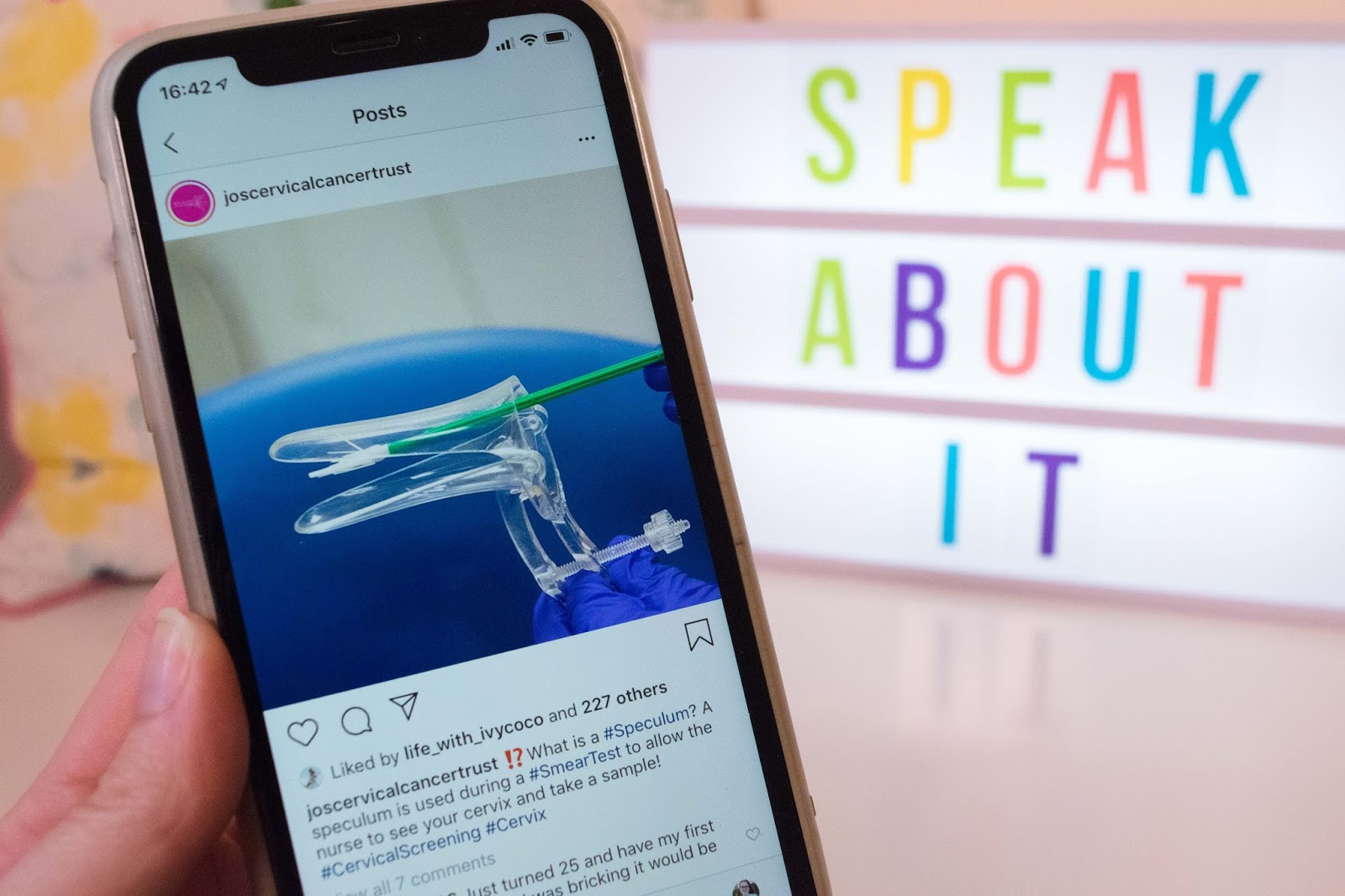
According to the charity Jo’s Cervical Cancer Trust, attendance for cervical screening (or smear tests) is at a 19-year low in England and a 10-year low in Scotland and Wales. This means that, when they receive their invitation letter, one in four women are not making an appointment to be checked. Things are going on to try and help reverse this shift. For example, the recent Channel 4 documentary about Jade Goody’s life, which includes her journey with cervical cancer, has got a lot of women talking about, and booking, their cervical screening tests. And recently, Zoe Sugg (aka. Zoella) uploaded a video that showed her having a smear test and asking the nurse various questions about the procedure. Over 1.4 million people have watched it so far. And it’s not just these high profile celebrities who are raising awareness of why it’s so vital to go for your cervical screening appointments. You only have to look at Instagram to see hundreds of thousands of pictures discussing the importance of having regular smears. 


And don’t get me wrong – this movement of women taking ownership of their health and encouraging others to do so too is fantastic. And for most people, these campaigns are enough to inspire them to book an appointment and get checked themselves. But the thing I struggled most with, was trying to find stories from people for whom having a smear test isn’t as straightforward as most people say it is. In amongst all the amazing posts and media about why it’s so important to have a smear test, I also found a lot of content shaming people for not having one. And that’s why I have decided to write this post. Not to put people off going for their appointments or to scare people off who haven’t been for a test yet. But to reassure others that they’re not alone if they struggle, for whatever reason, to go for their cervical screening. And that that struggle is nothing to be ashamed of. 


Like most women, I received an invitation to go for my first smear test just before my 25thbirthday. As someone that has had a huge number of medical tests over the years, I wasn’t too worried about the prospect of another one and so, fairly quickly, booked in with my GP Practice. On the day of my test, although feeling a little apprehensive about something new and different, I went in to see the nurse on my own, as I have done with many tests before. She asked me all the usual questions and told me how the test would be carried out, and then asked me to lay on the bed so she could proceed with the test. And this is where things started to go wrong. I found the test incredibly painful – so much so that I was in tears because of it. It didn’t help that the nurse I saw didn’t seem to be particularly gentle or sympathetic, and made comments about how difficult I was making it. After what felt like ages she finally managed to get the sample and I left feeling completely traumatised. 


Thankfully the result came back negative, so I tried to just forget about my experience for the next three years. But when my next invitation letter came three years later, the panic set in. I just couldn’t face going through that experience again. In the end, I went to talk to my GP about it. She told me that it was my choice whether I went to have the cervical screening done and that I didn’t have to get it done if I didn’t want to. But the problem was, I did want to – I knew how important the test was and I wanted to make sure I was doing everything I could to keep myself as healthy as possible. We talked about it quite a lot and in the end, decided that I would give it a try and if things really didn’t work, then we could talk again. She did also recommend asking the nurse to use a smaller speculum. 


And so, with a lot of apprehension, I booked in for my second cervical screening test. This time round, I decided to take my Mum into the test with me for some moral support. Pretty much as soon as I entered the room though, the nurse asked me why I’d brought my Mum in. I explained that I had found the test traumatic last time and for a couple of other reasons as well, I just needed someone I trusted with me. The nurse then told me that it was very strange that I would bring someone in with me and that she’d never seen anyone else need to do that before. My Mum was told to wait in the room next door while I had the test, so I was effectively on my own. So before we’d even started the test, I was feeling humiliated and upset for being what I now felt was strange. And the test didn’t go much better. We had the same problems with excruciating pain and the nurse not being particularly gentle while she tried to find my cervix. She kept telling me that my cervix was in a funny place and that I shouldn’t be in so much pain. Despite all this, somehow, she managed to take a sample and I left. 

I remember leaving the Doctors Surgery and bursting into tears – I felt like there must be something really wrong with me. Everyone else I had spoken to or heard talk about having a smear test said it was, at worst, a bit uncomfortable, but was over in a couple of minutes. So why wasn’t it like that for me? Ever since then, I have felt embarrassed about the whole process and the fact I couldn’t do what every other women could apparently do. 


Then a few months ago, I received my next invitation letter and my anxiety hit the roof again. This time, I really was tempted to just not go because after two horrible experiences and some other life events that have happened, it felt like burying my head in the sand was the easiest thing to do. Problem was, I had been getting some bleeding in between my periods and knew that, if I went to see my GP about it, the first thing she would say is that I needed a smear test. Plus, the bleeding was also giving me massive anxiety because I had no idea what was causing it. So I could either ignore my letter and continue to worry about the bleeding, or book an appointment and worry about the test instead. I went for the second option.

Out of all the medical tests I’ve had (and some have been pretty horrible) I think this was the one I felt most anxious about. In the weeks leading up to my appointment I was getting panic attacks, not sleeping properly, nightmares and generally just felt awful. The day came and this time my appointment was with a new nurse I had never seen before. I decided to go in on my own and I’m pretty sure as soon as I sat down the nurse could tell how anxious I was! She talked to me for quite a while, going through the normal questions and asking about previous tests. I tried to explain to her about the problems I had had with my previous tests and how worried I was about being there. I also spoke about my Ehlers-Danlos Syndrome, and how it can make it more painful to lie in the correct position. She was very sympathetic, listened to me and I didn’t feel judged at all, which started to put me at ease. As I lay on the bed, she explained exactly what she would be doing and showed me the instruments she would be using. She had got out a smaller speculum at my request and showed me exactly how it worked. Then she told me she would talk me through everything she was going to do and that if, at any time, I was finding it too difficult, I could ask her to stop.


The first time she tried I think I nearly shot through the roof because of the pain it caused, but true to her word, she immediately stopped and gave me some time to just breathe, move around and relax. When I was ready, she tried again, and this time, although it was uncomfortable, I wouldn’t say it was painful. I tried to focus on my breathing to keep myself calm, but after a while, the nurse told me that she was unable to find my cervix and would need to try again. My heart sank. But the nurse was lovely about it. She told me to make my hands into fists and then place them under my bottom, as this would help to tilt my cervix into a better position. She then tried again, and in a couple of minutes the test was complete. I think I nearly cried with relief this time rather than from pain or embarrassment. 


After I’d got dressed, I sat down with the nurse again, and she told me that I have a tilted cervix, which is what makes it harder to find. She reassured me that a lot of women have it, so it’s nothing strange or abnormal about me. She also told me that I have something called a cervical ectropion, which is very common among women who are on the pill, and could well be causing some of the pain and bleeding. I honestly just wanted to cry – finally someone was explaining to me why I might find having a smear test more difficult than some. This time, I left my appointment feeling relieved and empowered, all because I had a supportive nurse that really listened to my needs and worries.


Now don’t get me wrong, I’m still pretty anxious about having to have my next cervical screening in three years time because I know that it is still likely to cause me pain. And being disabled just adds to the issues by making it more difficult to access. But I guess I wanted to tell my story because it shows just how important it is to find a medical professional that you can really talk to about your worries when it comes to your smear test. There are so many different things that can be put in place to make the experience more manageable for you – that could be using a different sized speculum, having a friend/relative come with you (which, by the way, is completely normal and lots of people do it!), making adjustments for a disability or even going to a specialist hospital clinic for people who find smear tests particularly difficult.


So whether it’s your first smear and you’re scared of the instruments they use, whether you need to wear fancy underwear or if they will judge you for how you look down there. Or if it’s your third, fourth, fifth plus test and you’ve had experiences in the past that might make the whole process more difficult for you. My biggest piece of advice is to just talk to someone. Whether that’s your Mum, sister, friend, GP, the nurse or even a charity like Jo’s Trust (0808 802 8000). If something is worrying you about your smear test – anything at all – please talk to someone. I promise you’re not alone in finding it difficult. And the more we speak about our own experiences, the more people will realise that every smear test is different and that it’s OK if yours isn’t a straightforward process. 


Have you found having a smear test difficult? What advice would you give to others in a similar position? 

Wednesday, 15 May 2019

Mental Health Awareness Week - Body Image #BeBodyKind

If you’ve followed my blog for a while, watch my YouTube videos or follow me on Instagram, then you will probably be aware that I’ve struggled with mental health problems since my teenage years. I like to try and raise awareness of mental illness whenever I can, so when Mental Health Awareness Week comes around, it’s the perfect opportunity for me to create some content to help people understand mental illness that little bit more. 

The Mental Health Foundation started Mental Health Awareness Week in 2001 and for one week each May, they campaign around a specific theme. Since 2001, they have raised awareness of topics like stress, relationships, loneliness, sleep, alcohol and friendship. Hundreds of schools, businesses and communities have come together to start conversations around mental health that can change and even save lives. And this year, with our support, they want to reach more people than ever.


Last year, The Mental Health Foundation found that 30% of all adults have felt so stressed by body image and appearance that they felt overwhelmed or unable to cope. 

So, from 13th-19th May 2019, the focus for Mental Health Awareness Week is Body image – how we feel and think about our bodies. 

It’s pretty common to have body image concerns as you go through life, and a lot of the time this doesn’t lead to a mental health problem. However, it’s important to realise that worries about body image can be a risk factor for mental illnesses and research has found that higher body dissatisfaction is associated with poorer quality of life, psychological distress and the risk of unhealthy eating behaviours and eating disorders. It’s also important to know that body image concerns can affect anyone – men and women, children and adults.


In preparation for Mental Health Awareness Week, the Mental Health Foundation conducted some new online surveys with YouGov in March 2019. They found that:
·     One in five adults (20%) felt shame, just over one third (34%) felt down or low, and 19% felt disgusted because of their body image in the last year
·     Among teenagers, 37% felt upset, and 31% felt ashamed in relation to their body image
·     Just over one third of adults said they have ever felt anxious (34%) or depressed (35%) because of their body image
·     One in eight (13%) adults experienced suicidal thoughts or feelings because of concerns about their body image
·     Just over one in five adults (21%) said images used in advertising had caused them to worry about their body image
·     Just over one in five adults (22%) and 40% of teenagers said images on social media caused them to worry about their body image

With these figures in mind, I wanted to use this post to share some of my experiences of body image concerns and how they have affected my own mental health over the years. 


I don’t really remember ever being particularly aware of my body image until I reached Junior School at the age of seven or eight. Up until then, I had been fairly happy and carefree, and the only thing about my body that occurred to me was making sure it did all the things I wanted to do (playing, sleeping, eating etc.) But when I got to Junior School, I started being bullied. I vividly remember the first time someone made a comment about my body. We were walking back to our classroom after a P.E. lesson, and the boy in the line behind me gave me a kick and called me fat. I don’t recall ever being referred to as fat before then, and I think it must have set my mind whirring. All of a sudden, I became very self-conscious about my body. I was worried about what clothes I wore in case they showed off too much of my body. I hated doing any kind of sport at school because I suddenly just felt like some sort of elephant next to everyone else. I just didn’t want anyone to see me.

The bullying continued throughout Junior School and into Senior School. I wouldn’t say I was an unhappy child – I had a lovely group of friends and I think having them around me took some of the impact away from the bullies. But their comments and actions still hurt and they still affected me. I was always conscious about my body, no matter what I was doing. Even if I was just sat in lessons, I seemed to be hyper-aware of where my body was placed, how I was moving and what everyone else thought of me. Looking back, I don’t think I was a fat child. Sure, I wasn’t really skinny, but I definitely wasn’t overweight. But at the time, those comments just stuck in my mind and I couldn’t let them go.


I think body concerns are often amplified as you go through your teenage years. Your body is changing in ways you may not like or understand, and you have very little control over it. And at the same time, fitting in with your peers seems more important than ever. By the time I reached around the age of 14 or 15, I was starting to find my own way a bit. Fitting in with everyone else wasn’t quite so important, and I had a group of friends who were all different and had their own individual styles and paths they were following. Although I still had body image worries, I was starting to feel more secure in myself. And then I became unwell.

There’s never a good time to get ill, but right at the start of your GCSE years seemed particularly bad timing. All of a sudden, everything was being flipped on its head. I wasn’t able to go to school, I lost contact with a lot of my friends and I was spending a lot of my time either at medical appointments or at home, isolated, feeling really unwell. It’s really hard to have a positive body image when your body isn’t working properly. My illness (which at the time we had no idea what it was – now we know it was my Ehlers-Danlos Syndrome and related conditions) was doing all sorts of things to my body. I lost a lot of weight; I was in terrible pain, felt exhausted all the time and was getting all sorts of strange symptoms. 

It was the weight loss that seemed to attract the majority of comments and attention. Some comments were positive to begin with – saying that I looked good/well etc. But even when I started getting more concerned comments about my weight and my health, my mind was already fixed on losing weight. I’d only ever heard people telling me I was fat before (I’m sure those that loved me dismissed those ideas, but I think I probably only focused on the negative stuff), so to have people now telling me I was thin or too skinny felt kind of good in a weird way. I guess perhaps because I had been called fat for so long and it had made me so upset, that hearing the opposite from people felt like a huge positive. 


I’m not saying it was just these comments that caused me to slip into the depths of an eating disorder because that would be too simplistic, but the long-term bullying and the quick turn-around definitely contributed to it. And before I (and a lot of the people around me) realised, as well as having complex physical health problems, I was also drowning in mental illness. I was clinically depressed and had an eating disorder. 

Eating disorders (whichever type you have) really screw with your body image. No matter how much weight I lost, it was never enough, and I still believed I was too fat. I hated looking at my reflection in the mirror, but at the same time I had this compulsion to check myself to look at which parts of my body I needed to change. Eating disorders are addictive. I would weigh myself several times a day and became obsessed with the numbers on the scales. If they went up, it was the end of the world and I would need to reduce my intake even more or get rid of what I had already eaten. If the number went down, I would get this moment of elation that I had done something right, but that would soon turn to anxiety and the need to make it go down even further. You just get completely lost in this eating disorder bubble of numbers, reflections, food, weight and constant anxiety. 

I look back at photos from my worst times with my eating disorder now, and can see how terribly thin and frail I was; even just a few years ago when I had another relapse. It scares me that I just couldn’t see it then. But that’s what mental illness can do to your perception of body image. And what scares me even more is that, sometimes, when I’m feeling particularly low or the eating disorder thoughts are becoming stronger again, I can look at those pictures, look in the mirror or look at the number on the scales and want to go back to being that thin again. Even now, when I’m in a much more stable place, I know that it only needs something small to tip me back into the clutches of my eating disorder. Every day I have to find the strength to fight with my eating disorder to make sure I win and it doesn’t. Every day, even when I look in the mirror or see a photo of myself and the first thing that comes to my head is ‘I look fat,’ I have to somehow convince myself that my mind is playing tricks on me and that it’s my eating disorder speaking.


I remember being in eating disorder treatment (several times!) and one of the things we were told to do was to look at our bodies in a different way. Instead of looking just at the outside, like you do when you look in a mirror, we should look at what’s going on inside. What our body is doing inside to allow us to do all the things we want to do. Looking at our body in a much more practical and almost mechanical way, being grateful to it for working so we could do things like go shopping, go to the gym, hang out with friends, have children or anything else that meant something to us. And being kind to our body because of these things.

Now, I can see how this can work in a generally healthy individual. But it’s a technique I really struggle with because of my physical health problems. My body isn’t working properly. It isn’t allowing me to do all the things I want to do. It keeps breaking and malfunctioning; making me feel unwell and terrible. Don’t get me wrong – I do try to be grateful for what my body can do and I know others have it far worse than me. But when you’re already fighting with your body image, it’s really hard to feel any love for a body that just won’t work properly. And I know this is quite common amongst people with long-term illnesses. 

It’s really hard to feel good about your body when you’re trying to get your head around everything an illness is doing to it: 
·     Taking medications that change the way you look 
·     Having embarrassing medical situations (i.e. fainting, seizures, sickness, losing control of your bladder or bowels) in front of people you don’t know
·     Having to rely on others and lose your independence at a time when you should be making your own way in life
·     Having invasive tests that feel like they take away your dignity 
·     Feeling like you are losing your identity
·     Having to use mobility aids like sticks and wheelchairs, which completely change the way other people look at you


There are so many ways that having a long-term illness can affect a person’s body image, especially if you are also struggling with mental health problems already. As a young woman, I find it really difficult to feel attractive and to form relationships when I struggle to find the energy to get dressed, put on make-up and go out to meet people. Despite loving my wheelchair and mobility aids for what they allow me to do, they still affect my body image massively and make me almost feel invisible at times. For me, and for many others, it can be so hard to love your body when actually, a lot of the time, you really do hate it. 

Even now, at the age of 30, I still find myself comparing myself to images of other people on social media. Now, I love social media when it’s used in a healthy way or for doing good. But I also realise just how hard it makes it for young and old alike to feel positive about themselves. There are so many ‘beautiful’ people out there posting photos of themselves and their lives, and because social media is always there, it can be hard to get away from perceived perfection. In reality, I know that no one is perfect and beauty is simply one person’s perception. But if you’re already struggling with a mental illness, body image worries or are vulnerable to things like this, it can be so easy to get pulled in to comparing yourself with others on places like Instagram, Facebook and YouTube. When I was in the depths of my eating disorder, I would almost punish myself by following accounts that I knew made me feel inadequate, ugly or fat. These days, although I can still feel bad about my own body when I see someone I feel looks nicer than me, I’m much more in tune with my thoughts and can usually tell if I need to take a break from looking at social media. And I also try to follow a range of accounts with people of all different body shapes and sizes – it’s helping me to see that you don’t have to look a certain way to be beautiful or to be loved.


The Mental Health Foundation are hoping that their report and the awareness raised during Mental Health Awareness Week will help us all to feel better about our bodies and to reach out for help when we don’t. They have a series of tips to help us improve how we feel about our bodies and to help us to protect, promote and maintain a positive body image throughout our lives:

1.   If your body image is a significant cause of stress, or if you’re being bullied about how your body looks, consider talking to a friend, a trusted adult or a health professional
2.   Spring-clean your apps on your smartphone – be aware of how you feel when using them
3.   Look at the people in the accounts you’re following on social media and be mindful of how you feel about your own body and appearance when you look at them
4.   If you see an advert in a magazine, on television, or online that you think presents an unhealthy body image as aspirational, you can complain to the Advertising Standards Authority
5.   At home, parents and carers can lead by example by modelling positive behaviour around body image, eating healthily and staying active
6.   Our language is important. In our daily lives, we can all be more aware of the ways in which we speak about our own and other people’s bodies in casual conversation with friends and family
7.   Find the best way that works for you to stay active – make sure it’s suitable for you and your health though

They are also running a body image challenge – it’s easy to take part and they would love to have as much support as possible. Simply post on social media a picture of a time or a place when you have felt comfortable in your own skin – this could be now, five years ago or at the age of five. It can be a photo of yourself or something else that reminds you of that moment. Use the hashtags #BeBodyKind and #MentalHealthAwarenessWeek and tag @mentalhealthfoundation


I really hope that this post has helped to raise awareness of body image and mental illness, and that hearing some of my story has helped someone else feel less alone in their struggles. If you have any questions or comments, please do let me know, and if you want to share this post on social media or with anyone you know, please do tag me so I can follow where it goes.

For any help and support with mental illness, you can contact a number of places including:

·     Samaritans - on 116 123 for free, 24/7
·     Mind - on 0300 123 3393, Monday-Friday 9am-6pm
·     Beat - on 0808 801 0711, 365 days a year, 12pm-6pm Monday-Friday and 4pm-8pm weekends and bank holidays
·     CALM - on 0800 58 58 58, 365 days a year, 5pm-midnight
·     Maytree - on 0207 263 7070


Can you relate to anything I’ve spoken about with regards to body image and mental health?